Family Hodotermopsidae · 原白蚁科
Filter the taxa recorded under this family by name and locality; for the whole site use the full-text search.
Distribution map
Photographs 1 photo · 1 species
Freely licensed photos; click to enlarge. This preview shows 6 photos; to browse by species, open “All photos”. Photos are hotlinked from iNaturalist / Wikimedia Commons; the rights stay with the photographers.

About the family
The family Hodotermopsidae was proposed by Engel in 2021(11). The type genus is Hodotermopsis Holmgren, 1911. The family name derives from the type genus: Hodotermopsis means “resembling Hodotermes”, formed from Hodotermes plus the Greek opsis (appearance). This checklist includes 1 genera and 1 species.
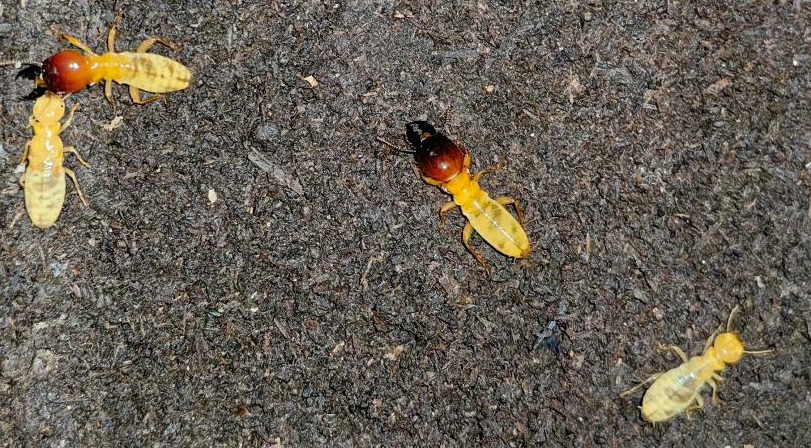
The living species Hodotermopsis sjostedti is distributed in Japan, Taiwan (China), southern China and Vietnam(12). Consistent with its close relatives, Hodotermopsis inhabits moist, decaying wood; the colony nests inside fallen logs and lives in a single-piece wood nest, with labor within the nest performed by pseudergates. The soldiers have a subquadrate-oval, flattened head with the anterior half darker; the vertex bears a central depression; the ocelli are distinct and kidney-shaped; the mandibles are robust and symmetrical, the left mandible bearing four and the right mandible two large marginal teeth; the antennae have 22–24 segments; the pronotum is crescent-shaped and slightly narrower than the head. The winged adults are 12–13.5 mm long, with 21–26 antennal segments and the forewing scale slightly larger than the hindwing scale. Economically, Hodotermopsis sjostedti damages living and felled trees in southern China and is a wood-boring pest(13)
This section is the standing account the site maintains for this rank and is updated on this page as the classification is revised; the checklist index is in the Checklist.
Fauna Sinica account
The account below is a reorganized and rewritten adaptation of the family-level description in Fauna Sinica, Insecta Vol. 17, Isoptera (2000) (original work, section on the family Hodotermitidae); the source keys and measurement tables are not reproduced here.
Morphology
Key characters
The grass termites recorded in the book belong to one of the more primitive branches of the Isoptera. No caste has a fontanelle; the pronotum is flat and narrower than the head; the first tarsomere of the hind leg is cleft only on its ventral surface and remains a single segment dorsally, so that the tarsus appears five-segmented in ventral view but only four-segmented in dorsal view; the cerci consist of four to eight segments; the alate lacks ocelli and has antennae of fifteen to twenty-seven segments; the soldier's tibiae bear two to four apical spurs. The transformed caste (the soldier) approaches the primitive type in head shape, mandibular teeth and the number of antennal and cercal segments; caste differentiation is not pronounced, and many ancestral characters are retained.
Soldier
The soldier of the single genus recorded for China has a broad, flattened, nearly circular head capsule, with the posterior and lateral margins both rounded; the antennae are many-segmented, up to twenty-four segments; the compound eyes are distinct; the mandibles are robust and strongly curved, with very well developed mandibular teeth, the left mandible bearing four marginal teeth and the right three. The pronotum is flat and slightly narrower than the head; the hind tibia bears two lateral spurs in addition to four apical spurs, whereas the fore and mid tibiae have no lateral spurs; the cerci have four to six segments.
Biology and economic significance
This group inhabits moist forests, boring into damp logs, fallen timber and stumps, and also damages living trees and the timber of cottages and old buildings; hence the name dampwood termites. Primary and secondary forests suffer especially heavily. Their galleries have no connection with the soil, and they live a concealed, wood-dwelling life.
Distribution
The book records only one genus and one species as extant in China, found in subtropical montane and hilly forests; the precise localities and hosts are given on the species page for this genus.
Summary
In the 2000 account, Chinese members of this group are small, wood-dwelling termites retaining many ancestral features. Every caste lacks a fontanelle, the pronotum is flat and narrower than the head, the first hind tarsal segment is cleft only below (five segments seen from beneath, four from above), and cerci comprise four to eight segments. Alates have no ocelli and 15 to 27 antennal segments; soldiers bear two to four tibial spurs. Colonies live in damp timber and are known as dampwood termites.
Taxonomic note: The original work follows the system of Snyder and Emerson, placing the subfamily Termopsinae within the family Hodotermitidae (noting that the subfamily had been proposed for elevation to the family Termopsidae). This subfamily was later generally raised to the separate family Hodotermopsidae; this site follows the current system, so what is presented on this page is in fact the part of the original work's Hodotermitidae that concerns the Chinese species.
Sources cited: Huang Fusheng, Zhu Shimo, Ping Zhengming, Wang Zhiguo, Li Can and Xu Chungui, 2000. Fauna Sinica, Insecta Vol. 17, Isoptera. Beijing: Science Press. This text is a reorganized adaptation, not a verbatim transcription.
Genus (1)
- Hodotermopsis 原白蚁属 1 species
Parent level: Checklist index · Data & downloads