Family Stylotermitidae · 杆白蚁科
Filter the taxa recorded under this family by name and locality; for the whole site use the full-text search.
Distribution map
About the family
The family Stylotermitidae is a monotypic extant family, containing only the genus Stylotermes Holmgren & Holmgren, 1917. The group was established by Holmgren and Holmgren in 1917, with Stylotermes as the type genus. The family name is derived from the type genus, from the Greek stylos (column) plus termes. (3) This checklist records 1 genera and 45 species.
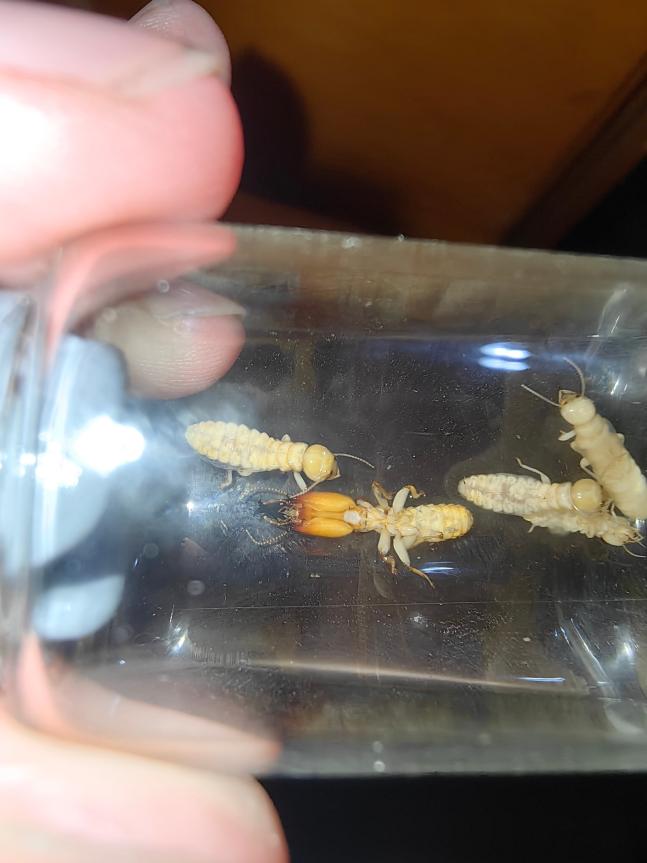
This family is endemic to the Oriental realm (southern and southeastern Asia). About 35 species are endemic to the mountains of southern China, and the family ranges westward to India and Bangladesh, eastward to Taiwan, China, and southward to Brunei and Malaysia; China is the modern center of diversification for the family, and there are also collecting records from the mountains of northeastern India. Unlike most wood-dwelling termites that inhabit dead fallen wood, Stylotermes lives inside the wood of living trees or very recently dead trees, being a concealed wood-dwelling termite; it has no true worker caste, labor being performed by pseudergates, and the soldiers have an elongate, narrow head capsule and scimitar-shaped mandibles. In this family the alates have a nearly round head, an extremely small fontanelle that is sometimes externally invisible, small ocelli, 16–22-segmented antennae, and a flat pronotum. In all castes of the family the tarsi are 3-segmented and the tibial spur formula is 3:2:2, a primitive character rarely seen among extant termites. The soldiers and workers possess a small but active frontal gland that secretes monoterpene compounds for defense (studied in S. faveolus and S. halumicus); trail-following pheromones have also been specifically reported in these two species (27). Phylogenetically, the family is the sister group of all other Neoisoptera, being the earliest-diverging extant lineage of the Neoisoptera, and is of great significance for understanding the evolution of the frontal gland and of caste differentiation. Economically, the family inhabits living trees and nests within living standing timber, being a rare tree-living group among termites that can weaken and even kill living trees (28).
This section is the standing account the site maintains for this rank and is updated on this page as the classification is revised; the checklist index is in the Checklist.
Genus (1)
- Stylotermes 杆白蚁属 45 species
Parent level: Checklist index · Data & downloads