Genus Acorhinotermes · 尖鼻白蚁属
Filter the taxa recorded under this genus by name and locality; for the whole site use the full-text search.
Distribution map
Photographs 4 photos · 2 species
Freely licensed photos; click to enlarge. This preview shows 6 photos; to browse by species, open “All photos”. Photos are hotlinked from iNaturalist / Wikimedia Commons; the rights stay with the photographers.


About the genus
This genus belongs to the family Rhinotermitidae 鼻白蚁科; the site records 3 species.
Type species: Acorhinotermes subfusciceps.
This page includes a distribution map for the genus (GBIF records aggregated on a 1° grid); open a species entry to see its type locality, distribution, and references.
Etymology
Contains Greek rhis (nose) + Latin termes; prefix derivation uncertain.
The etymologies in this section are analytical breakdowns; the roots follow Brown (1956).
Morphology
The descriptions below are an adaptation of the original genus-level accounts; terms follow the meaning of the source, and the original is not transcribed verbatim.
Diagnostic characters
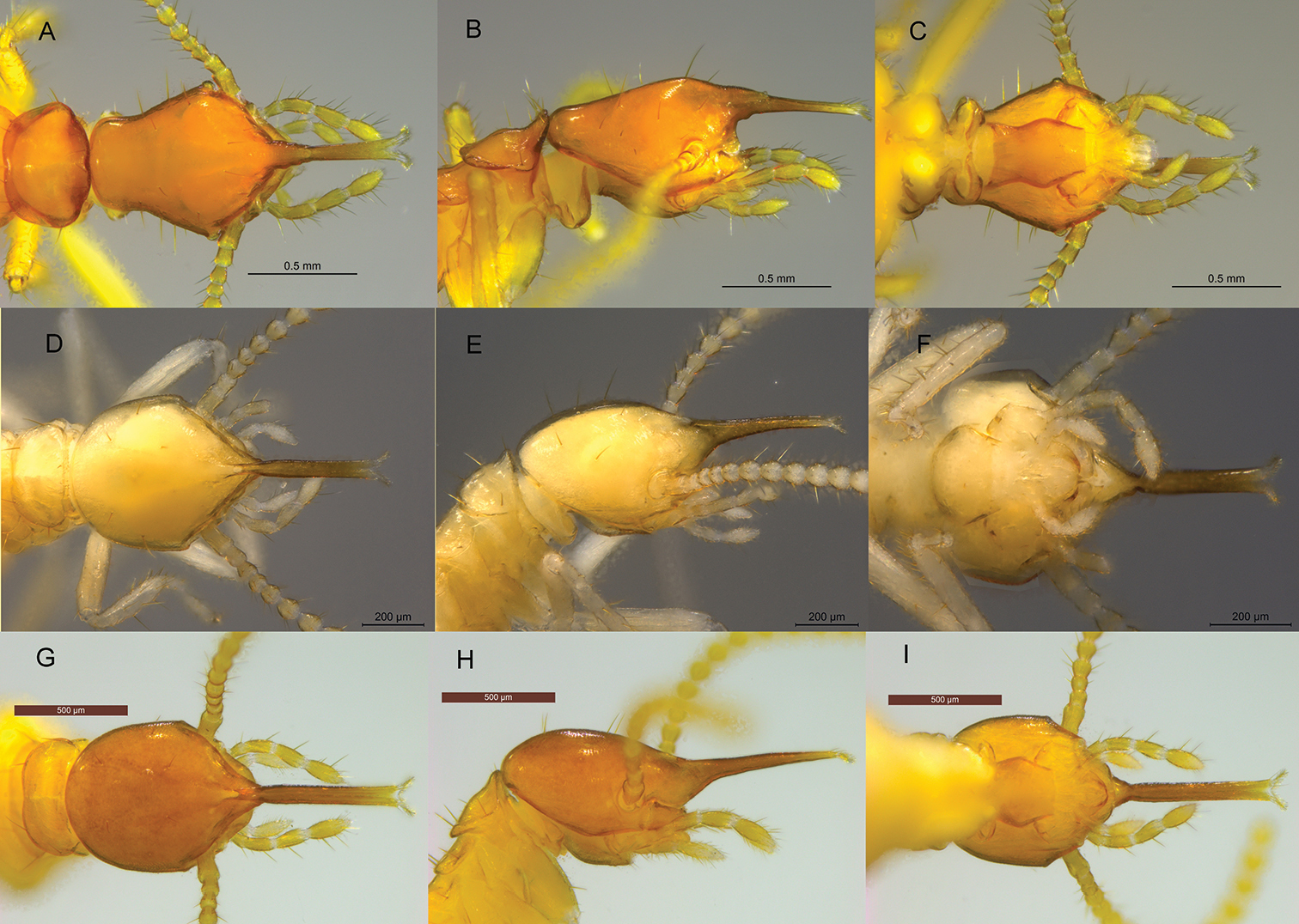
The diagnostic character at generic level is the absence of a major soldier, the feature on which Emerson based the removal of the species from Rhinotermes and the erection of this genus; in dorsal view the fontanelle of the minor soldier lies in front of the mandibular lobes (that is, the bases of the mandibular points), which separates it from Dolichorhinotermes and Rhinotermes, in both of which the fontanelle lies at or behind the mandibular lobes.
Soldier
Only the minor soldier is known. In dorsal view the sides of the head are concave, producing a posterior constriction; the vertex bears 10–12 long, erect setae and no microtrichia; antennae 15 or 16 segments, with the formula 2=3<4=5; mandibles reduced, long, straight and sharp; labrum extremely long (hyperelongate), widening towards the apex, which is bilobed, and in lateral view almost in the same plane as the vertex; fontanelle situated at 1/5 of the length from the base of the labrum; pronotum concolorous with the head, bearing 4–8 scattered setae (2–4 on the anterior margin and 2–4 on the dorsum) and no microtrichia; abdominal segments pale yellow, densely hairy at the margins; legs with numerous long and short setae, the fore tibia with stout setae. The mandibular points of the minor soldier of this species are longer than in A. subfusciceps, and the body is relatively smaller.
Sources: Castro Torres, D.; Scheffrahn, R. H. 2019. A new species of Acorhinotermes Emerson, 1949 (Blattodea, Isoptera, Rhinotermitidae) from Colombia, with a key to Neotropical Rhinotermitinae species based on minor soldiers. ZooKeys 891: 61–70. https://doi.org/10.3897/zookeys.891.37523, Introduction; Key to the species of Neotropical Rhinotermitinae (couplet 1); Acorhinotermes claritae, Diagnosis and Description This text is an adaptation, not a verbatim transcription of the original.
Species (3)
Parent level: Checklist index · Rhinotermitidae 鼻白蚁科 · Data & downloads