Family Rhinotermitidae · 鼻白蚁科
Filter the taxa recorded under this family by name and locality; for the whole site use the full-text search.
Distribution map
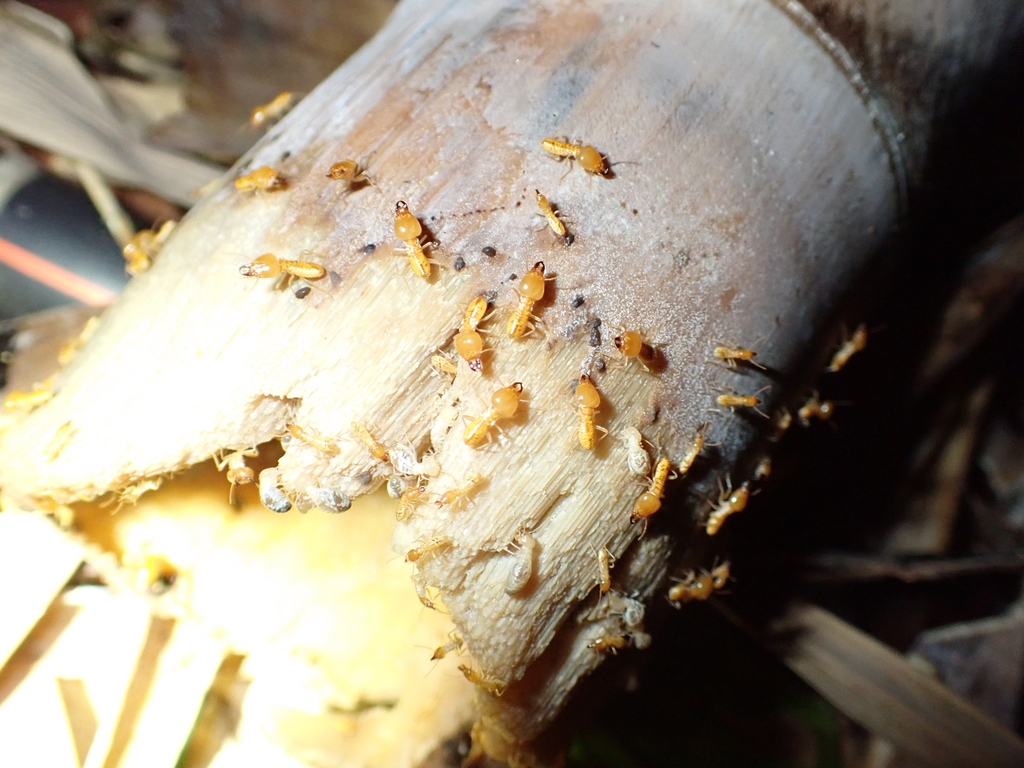
Photographs 71 photos · 11 species
Freely licensed photos; click to enlarge. This preview shows 6 photos; to browse by species, open “All photos”. Photos are hotlinked from iNaturalist / Wikimedia Commons; the rights stay with the photographers.


About the family
The subfamily Rhinotermitinae was established by Froggatt in 1897; here the narrowly circumscribed Rhinotermitidae sensu novo, as redefined by the 2024 phylogenetic study, is adopted(21), containing 5 genera. The type genus is Rhinotermes Hagen, 1858; the family name is formed from the Greek rhis/rhinos (nose) and termes, referring to the raised, nose-like clypeus of the adults and the narrow groove running from the fontanelle to the clypeus. This checklist includes 5 genera and 62 species.
Acorhinotermes, Dolichorhinotermes and Rhinotermes are chiefly Neotropical (northern South America to the Caribbean); Parrhinotermes is chiefly Southeast Asian, extending west to northeastern India, north to Tibet and Yunnan of China, and east to Papua New Guinea, the Solomon Islands and Queensland, Australia; Schedorhinotermes is widely distributed in the Afrotropical and Oriental realms, Australia and the western Pacific islands. This family has a true worker caste, often nesting in the soil or in wood in contact with the soil, with the workers going out through tunnels to feed on wood; the soldiers are mostly dimorphic (a few trimorphic), with the labrum elongated and palp-like, brush-shaped at the tip and with a groove down the middle, along which the frontal-gland secretion flows to repel enemies—an important diagnostic character distinguishing this family from related families. In this family, the workers and winged adults bear three distinct, unequal marginal teeth behind the apical tooth of the left mandible; the anterior margin of the postclypeus is markedly arched in the winged adults, workers and soldiers; and the fontanelle of the soldiers lacks long setae around its margin. Economically, Schedorhinotermes commonly damages structural timber within its range, such as Schedorhinotermes intermedius in eastern Australia(25); Schedorhinotermes longirostris (native to India, Indonesia, Malaysia, Palau and Papua New Guinea, introduced to Guam, USA) was introduced into Guam in 2011 and damages the endemic cycads there.
This section is the standing account the site maintains for this rank and is updated on this page as the classification is revised; the checklist index is in the Checklist.
Fauna Sinica account
The account below is a reorganized and rewritten adaptation of the family-level description in Fauna Sinica, Insecta Vol. 17, Isoptera (2000) (original work, section on the family Rhinotermitidae); the source keys and measurement tables are not reproduced here.
Morphology
Key characters
The head bears a fontanelle, the most conspicuous feature of the family; the antennae have thirteen to twenty-five segments; the pronotum is flat and narrower than the head; the tarsi are four-segmented, with no arolium beneath the claws; the cerci have two segments. The alate and worker have three marginal teeth on the left mandible and two on the right, the first marginal tooth bearing a subsidiary tooth; the alate has ocelli, the forewing scale is larger than the hindwing scale and the two overlap, and the wing membrane bears cross-veins forming a network.
Biology and economic significance
Most species of this family are both soil- and wood-dwelling, and the nest may be built underground, in tree trunks or within objects on the ground; colony structure is comparatively complex. They feed on living trees, dead wood and structural timber, and can also damage leather, plastics, cable sheathing and even metal articles; several genera are major cosmopolitan pests, causing particularly severe damage to houses, bridges, utility poles and telecommunications installations.
Distribution
The family is species-rich and widely distributed, with the Oriental region as its centre of distribution and differentiation; some genera extend into the Neotropical, tropical and Australasian regions, and some species have established populations in the drier parts of the Northern Hemisphere. It occurs throughout China, north and south.
Summary
Rhinotermitids are recognised by a fontanelle on the head, antennae of 13 to 25 segments, a flat pronotum narrower than the head, four-segmented tarsi without an arolium, and two cerci. Alates and workers have three left and two right mandibular marginal teeth, the first with a subsidiary tooth; alates also show ocelli, overlapping wing scales and a reticulate wing membrane. Most species nest in soil or wood and several are worldwide structural pests.
Taxonomic note: The original work's Rhinotermitidae includes groups that have since been separated or synonymised: the genus Stylotermes is now usually placed in a family of its own, Stylotermitidae; the genus Tsaitermes has been sunk into Reticulitermes; and several species of Coptotermes have also been revised. This site follows the current system, so this page does not correspond genus by genus to the chapter in the original work.
Sources cited: Huang Fusheng, Zhu Shimo, Ping Zhengming, Wang Zhiguo, Li Can and Xu Chungui, 2000. Fauna Sinica, Insecta Vol. 17, Isoptera. Beijing: Science Press. This text is a reorganized adaptation, not a verbatim transcription.
Literature notes
Edited notes based on the original literature, not transcriptions. The source markers in each paragraph point to archived records in .sources; full citations are listed below.
The split of Rhinotermitidae (2024)
According to the genomic phylogenetic study of Hellemans et al. (2024), Rhinotermitidae in the traditional sense (Rhinotermitidae sensu lato) is paraphyletic and was split into four family-level clades: Heterotermitidae (containing Coptotermes, Heterotermes and Reticulitermes), Psammotermitidae (containing Psammotermes and Prorhinotermes), Termitogetonidae (only Termitogeton), and Rhinotermitidae in the narrow sense (Rhinotermitidae sensu novo). Rhinotermitidae sensu novo retains only five genera, Acorhinotermes, Dolichorhinotermes, Parrhinotermes, Rhinotermes and Schedorhinotermes, that is, the former Rhinotermitinae (the old subfamily); Macrorhinotermes (a synonym) was treated as a junior synonym of Schedorhinotermes.
The revised Rhinotermitidae (Rhinotermitidae sensu novo) ranges across Australia, Africa, the Neotropics, the Oriental region, the Palaearctic (China and Japan) and Oceania; soldiers may be monomorphic, dimorphic or trimorphic; diagnostic features include an inflated clypeus, a narrow groove running from the fontanelle to the clypeus, and, in soldiers, an elongate labrum with a brush-like tip, the labrum bearing a median groove along which the frontal-gland secretion flows.
Consequently, 'Rhinotermitidae' in older literature cannot be equated throughout with the Rhinotermitidae (Rhinotermitidae sensu novo) of this checklist; where genera such as Coptotermes and Reticulitermes are encountered, they should be treated as Heterotermitidae.
References
Genera (5)
- Acorhinotermes 尖鼻白蚁属 3 species
- Dolichorhinotermes 狭鼻白蚁属 7 species
- Parrhinotermes 棒鼻白蚁属 13 species
- Rhinotermes 鼻白蚁属 4 species
- Schedorhinotermes 长鼻白蚁属 35 species
Parent level: Checklist index · Data & downloads