Genus Dolichorhinotermes · 狭鼻白蚁属
Filter the taxa recorded under this genus by name and locality; for the whole site use the full-text search.
Distribution map
Photographs 4 photos · 3 species
Freely licensed photos; click to enlarge. This preview shows 6 photos; to browse by species, open “All photos”. Photos are hotlinked from iNaturalist / Wikimedia Commons; the rights stay with the photographers.


About the genus
This genus belongs to the family Rhinotermitidae 鼻白蚁科; the site records 7 species.
Type species: Dolichorhinotermes longilabius.
This page includes a distribution map for the genus (GBIF records aggregated on a 1° grid); open a species entry to see its type locality, distribution, and references.
Etymology
From Greek dolichos (long) + rhis (nose) + Latin termes.
The etymologies in this section are analytical breakdowns; the roots follow Brown (1956).
Morphology
The descriptions below are an adaptation of the original genus-level accounts; terms follow the meaning of the source, and the original is not transcribed verbatim.
Diagnostic characters
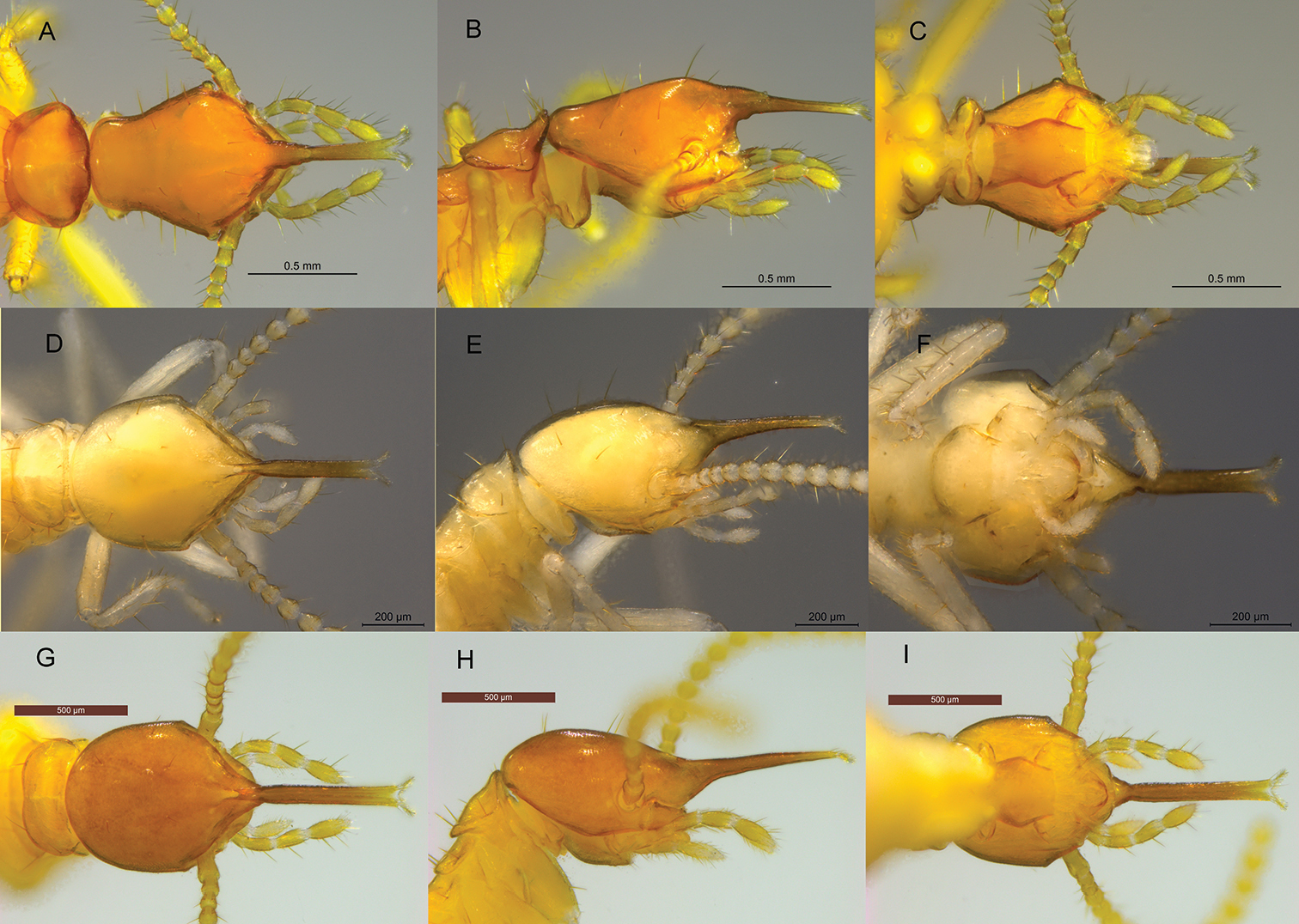
In the alate the 3rd flagellar segment is shorter than the 1st flagellar segment; in the major soldier the labrum is distinctly elongate, its apex often reaching the ends of the mandibles, whereas the labrum of Rhinotermes is almost square and much shorter; in the minor soldier the opening of the frontal gland lies on the anterior part of the head but is not borne on a distinct frontal projection, the mandibles are reduced with rounded margins, and in dorsal view the sides of the head are straight or convex.
Alate
The 3rd flagellar segment is shorter than the 1st flagellar segment. For the extant species D. lanciarius the original records the alate as 'Imago. Unknown.'; the alate of the fossil species D. apopnus: head large, broad and rounded, the anteclypeus projecting forwards as a broad beak-like process, the frontal gland small and situated at the base of the beak, the compound eyes large and protruding, the ocelli large and elongate and not touching the compound eyes.
Soldier
Major soldier: posterior part of the head broader, the sides gently rounded and narrowing forwards; left mandible with two coarse teeth, the first just before mid-length and the second slightly behind it, the first distinctly longer than the second; right mandible with two teeth near mid-length, the first shorter than the second; labrum elongate with a rounded apex, without an incision, and with a shallow longitudinal groove dorsally; antennae with at least 14 segments, the 3rd flagellar segment distinctly shorter than the 1st; pronotum saddle-shaped. Minor soldier: sides of the head weakly convex and narrowing forwards, the posterior margin rounded; antennae 16 segments, the 3rd flagellar segment distinctly shorter than the 1st; mandibles reduced to broad fleshy lobes bearing only minute sclerotised points; labrum narrow and long, forked at the apex, the two prongs widely separated.
Sources: Engel, M. S.; Krishna, K. 2007. New Dolichorhinotermes from Ecuador and in Mexican amber (Isoptera: Rhinotermitidae). American Museum Novitates 3592: 1–8. https://doi.org/10.1206/0003-0082(2007)3592[1:NDFEAI]2.0.CO;2, p. 2 (genus diagnosis); pp. 2–3 (D. lanciarius, major and minor soldier) This text is an adaptation, not a verbatim transcription of the original.
Species (7)
- Dolichorhinotermes japuraensis Constantino, 1991 雅普拉狭鼻白蚁
- Dolichorhinotermes lanciarius Engel & Krishna, 2007 矛唇狭鼻白蚁
- Dolichorhinotermes latilabrum Snyder, 1926 宽唇狭鼻白蚁
- Dolichorhinotermes longidens Snyder, 1924 长齿狭鼻白蚁
- Dolichorhinotermes longilabius Emerson, 1924 长唇狭鼻白蚁 ★ Type species
- Dolichorhinotermes neli Ensaf & Betsch, 2002 内尔狭鼻白蚁
- Dolichorhinotermes tenebrosus Emerson, 1925 暗色狭鼻白蚁
Parent level: Checklist index · Rhinotermitidae 鼻白蚁科 · Data & downloads