Genus Microcerotermes · 锯白蚁属
Filter the taxa recorded under this genus by name and locality; for the whole site use the full-text search.
Distribution map
Photographs 2 photos · 2 species
Freely licensed photos; click to enlarge. This preview shows 6 photos; to browse by species, open “All photos”. Photos are hotlinked from iNaturalist / Wikimedia Commons; the rights stay with the photographers.
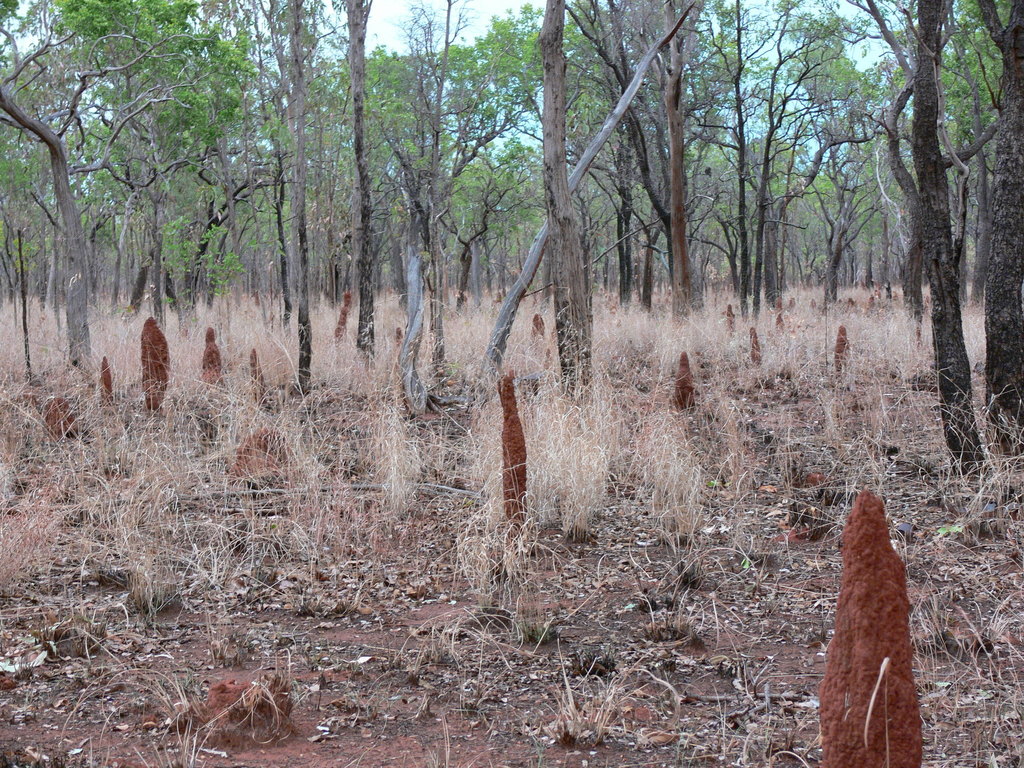

About the genus
This genus belongs to the family Termitidae 白蚁科, in the subfamily Microcerotermitinae 锯白蚁亚科; the site records 148 species, 7 subspecies.
Type species: Microcerotermes strunckii.
This page includes a distribution map for the genus (GBIF records aggregated on a 1° grid); open a species entry to see its type locality, distribution, and references.
Etymology
From Greek mikros (small) + keras (horn) + Latin termes.
The etymologies in this section are analytical breakdowns; the roots follow Brown (1956).
Fauna Sinica account
The account below is a reorganized and rewritten adaptation of the genus-level description in Fauna Sinica, Insecta Vol. 17, Isoptera (2000) (generic description in the original book's section on Microcerotermes, reorganised and rewritten); the source keys and measurement tables are not reproduced here.
Morphology
Key characters
Soldier head capsule rectangular and thick; frontal pore indistinct; mandibles long and sickle-shaped, the outer margin of the mandibular base mostly concave, the inner margin serrated; antennae with twelve to thirteen segments; pronotum saddle-shaped, much narrower than the head.
Soldier
Soldier head capsule rectangular, fairly thick. Frontal pore indistinct. The posterior margin of the postclypeus raised upwards. Labrum large, its apex rounded or truncate. Mandibles long, sickle-shaped to sabre-shaped, the outer margin of the base mostly concave inwards, the inner margin serrated. Antennae with twelve to thirteen segments. Pronotum saddle-shaped, much narrower than the head capsule. Styli poorly developed.
Alate
Alate head capsule oval, the lateral margins straight; compound eyes not large, protruding outwards. Ocelli small, slightly separated from the compound eyes. The frontal gland opening is often difficult to see. Postclypeus slightly raised, lower than the frons, its anterior margin straight. Antennae with thirteen to fourteen segments. Pronotum small, much narrower than the head capsule; the posterior part of the mesonotum wider than the metanotum. Wing membrane pale brown to dark brown, densely covered with short hairs; radius absent or vestigial; media close to the cubitus. Male with styli. Tibial spur formula 3:2:2.
Biology and economic significance
This genus damages many kinds of crops, forest trees and buildings. In the Arabian Peninsula and elsewhere a Middle Eastern Microcerotermes severely damages timber-framed buildings as well as date palms, cotton and citrus, while in tropical Africa a Microcerotermes with dark tibiae damages cotton and maize. Species of this genus have been intercepted many times in quarantine on timber imported into China.
Distribution
Oriental Region, Australasia, Africa and the Americas; five species are at present known from China, mostly in Yunnan and Hainan, closely related to species of the Indochinese Peninsula.
Summary
Microcerotermes soldiers have a thick rectangular head with an indistinct frontal pore, a large labrum, and long falcate or sabre-like mandibles whose outer base is often concave and whose inner margin is serrate. Antennae have twelve or thirteen segments, the pronotum is saddle-shaped and much narrower than the head, and the styli are rudimentary. Alates are oval-headed with small protruding eyes, thirteen or fourteen antennal segments, densely hairy brownish wings, and a reduced or absent radial vein.
Sources cited: Huang Fusheng, Zhu Shimo, Ping Zhengming, Wang Zhiguo, Li Can and Xu Chungui, 2000. Fauna Sinica, Insecta Vol. 17, Isoptera. Beijing: Science Press. This text is a reorganized adaptation, not a verbatim transcription.
Species (148 species, 7 subspecies)
- Microcerotermes acerbus Sjöstedt, 1911 粗鲁锯白蚁
- Microcerotermes algoasinensis Fuller, 1925 阿尔哥亚湾锯白蚁
- Microcerotermes amboinensis Kemner, 1931 安汶锯白蚁
- Microcerotermes annandalei Silvestri, 1923 安嫩代尔锯白蚁
- Microcerotermes apricitatis Fuller, 1925 阳光锯白蚁
- Microcerotermes arboreus Emerson, 1925 树栖锯白蚁
- Microcerotermes baluchistanicus Ahmad, 1955 俾路支锯白蚁
- Microcerotermes barbertoni Fuller, 1925 巴伯顿锯白蚁
- Microcerotermes beesoni Snyder, 1933 比森锯白蚁
- Microcerotermes bequaertianus Sjöstedt, 1913 贝奎特锯白蚁
- Microcerotermes biroi Desneux, 1905 比罗锯白蚁
- Microcerotermes biswanathae Maiti & Chakraborty, 1994 比斯瓦那塔锯白蚁
- Microcerotermes boreus Hill, 1927 北部锯白蚁
- Microcerotermes bouilloni Roisin & Pasteels, 2000 布永锯白蚁
- Microcerotermes bouvieri Desneux, 1904 布维尔锯白蚁
- Microcerotermes brachygnathus Silvestri, 1914 短颚锯白蚁
- Microcerotermes brevior Desneux, 1905 狭小锯白蚁
- Microcerotermes buettikeri Chhotani & Bose, 1979 比特铁克锯白蚁
- Microcerotermes bugnioni Holmgren, 1911 布格尼恩锯白蚁
- Microcerotermes cachani Eggleton, 2003 卡占锯白蚁
- Microcerotermes cameroni Snyder, 1934 卡梅伦锯白蚁
- Microcerotermes cavus Hill, 1942 凿洞锯白蚁
- Microcerotermes celebensis Kemner, 1934 西里伯斯锯白蚁
- Microcerotermes chaudhryi Akhtar, 1974 乔德里锯白蚁
- Microcerotermes chhotanii Ghayourfar, 1998 乔塔里锯白蚁
- Microcerotermes choanensis Fuller, 1925 乔安锯白蚁
- Microcerotermes collinsi Fuller, 1925 柯林斯锯白蚁
- Microcerotermes crassus Snyder, 1934 大锯白蚁
- Microcerotermes cupreiceps Roisin & Pasteels, 2000 铜头锯白蚁
- Microcerotermes cylindriceps Wasmann, 1902 筒头锯白蚁
- Microcerotermes dammermani Roonwal & Maiti, 1966 达梅尔曼锯白蚁
- Microcerotermes danieli Roonwal & Bose, 1970 丹尼尔锯白蚁
- Microcerotermes dashlibronensis Ghayourfar, 2005 达什利布龙锯白蚁
- Microcerotermes debilicornis Holmgren, 1913 软角锯白蚁
- Microcerotermes depokensis Kemner, 1932 德波锯白蚁
- Microcerotermes distans Haviland, 1898 遥远锯白蚁
- Microcerotermes distinctus Silvestri, 1909 易识锯白蚁
- Microcerotermes diversus Silvestri, 1920 不同锯白蚁
- Microcerotermes dolichocephalicus Gao & Lam, 1992 长头锯白蚁
- Microcerotermes dolichognathus Silvestri, 1912 狭颚锯白蚁
- Microcerotermes dumasensis Thakur, 1989 杜马斯锯白蚁
- Microcerotermes dumisae Fuller, 1925 杜米萨锯白蚁
- Microcerotermes duplex Desneux, 1904 含糊锯白蚁
- Microcerotermes durbanensis Fuller, 1925 德班锯白蚁
- Microcerotermes edentatus Wasmann, 1911 缺齿锯白蚁
- Microcerotermes elegans Sjöstedt, 1925 苗条锯白蚁
- Microcerotermes eugnathus Silvestri, 1911 真颚锯白蚁
- Microcerotermes exiguus Hagen, 1858 微小锯白蚁
- Microcerotermes fletcheri Holmgren & Holmgren, 1917 弗莱彻锯白蚁
- Microcerotermes flyensis Roisin & Pasteels, 2000 弗莱锯白蚁
- Microcerotermes fuscotibialis Sjöstedt, 1896 棕胫锯白蚁
- Microcerotermes gabrielis Weidner, 1955 加布里埃利斯锯白蚁
- Microcerotermes ganeshi Bose, 1984 加内什锯白蚁
- Microcerotermes gracilis Light, 1933 细瘦锯白蚁
- Microcerotermes greeni Holmgren, 1913 格林锯白蚁
- Microcerotermes hamatus Holmgren, 1913 具钩锯白蚁
- Microcerotermes havilandi Holmgren, 1913 哈维兰锯白蚁
- Microcerotermes heimi Wasmann, 1902 埃姆锯白蚁
- Microcerotermes hypaenicus Fuller, 1925 海帕恩锯白蚁
- Microcerotermes ilalazonatus Fuller, 1925 伊拉拉佐纳图斯锯白蚁
- Microcerotermes implacidus Hill, 1942 易动锯白蚁
- Microcerotermes indistinctus Mathews, 1977 模糊锯白蚁
- Microcerotermes insularis Maiti & Chakraborty, 1994 岛屿锯白蚁
- Microcerotermes kudremukhae Chhotani, 1997 库德雷穆克锯白蚁
- Microcerotermes kwazulu Fuller, 1925 夸祖鲁锯白蚁
- Microcerotermes labioangulatus Sen-Sarma & Thakur, 1975 角唇锯白蚁
- Microcerotermes lahorensis Akhtar, 1974 拉合尔锯白蚁
- Microcerotermes lateralis Walker, 1853 侧移锯白蚁
- Microcerotermes laticeps Holmgren, 1913 宽头锯白蚁
- Microcerotermes laxmi Roonwal & Bose, 1964 拉克西米锯白蚁
- Microcerotermes leai Hill, 1927 莉锯白蚁
- Microcerotermes limpopoensis Fuller, 1925 林波波锯白蚁
- Microcerotermes longiceps Cachan, 1949 头长锯白蚁
- Microcerotermes longignathus Ahmad, 1955 长颚锯白蚁
- Microcerotermes longimalatus Sjöstedt, 1925 长腭锯白蚁
- Microcerotermes losbanosensis Oshima, 1914 洛斯巴尼奥斯锯白蚁
- Microcerotermes luluai Roisin & Pasteels, 2000 卢路亚锯白蚁
- Microcerotermes macacoensis Sjöstedt, 1925 马卡古锯白蚁
- Microcerotermes madurae Kemner, 1934 马都拉锯白蚁
- Microcerotermes major Cachan, 1951 大型锯白蚁
- Microcerotermes maliki Akhtar, 1974 马利克锯白蚁
- Microcerotermes malmesburyi Fuller, 1925 马姆斯伯里锯白蚁
- Microcerotermes mandibularis Cachan, 1951 具颚锯白蚁
- Microcerotermes manjikuli Sen-Sarma, 1966 曼志库尔锯白蚁
- Microcerotermes marilimbus Ping & Xu, 1984 海角锯白蚁
- Microcerotermes masaiaticus Harris, 1954 马赛亚特锯白蚁
- Microcerotermes minor Holmgren, 1914 小型锯白蚁
- Microcerotermes minutus Ahmad, 1965 小泰锯白蚁
- Microcerotermes mzilikazi Fuller, 1925 姆兹立卡兹锯白蚁
- Microcerotermes nanulus Sjöstedt, 1925 短小锯白蚁
- Microcerotermes nanus Hill, 1915 侏儒锯白蚁
- Microcerotermes nemoralis Harris, 1954 树林锯白蚁
- Microcerotermes nervosus Hill, 1927 强健锯白蚁
- Microcerotermes newmani Hill, 1927 纽曼锯白蚁
- Microcerotermes nicobarensis Roonwal & Bose, 1970 尼科巴锯白蚁
- Microcerotermes novaecaledoniae Holmgren & Holmgren, 1915 新喀里多尼亚锯白蚁
- Microcerotermes pakistanicus Akhtar, 1974 巴基斯坦锯白蚁
- Microcerotermes palaearcticus Sjöstedt, 1904 古北锯白蚁
- Microcerotermes palestinensis Spaeth, 1964 巴勒斯坦锯白蚁
- Microcerotermes papuanus Holmgren, 1911 巴布亚锯白蚁
- Microcerotermes paracelebensis Ahmad, 1965 似西里伯斯锯白蚁
- Microcerotermes parviceps Mjöberg, 1920 小头锯白蚁
- Microcerotermes parvulus Sjöstedt, 1911 细小锯白蚁
- Microcerotermes parvus Haviland, 1898 小锯白蚁
- Microcerotermes pauliani Krishna, 2013 波利昂锯白蚁
- Microcerotermes peraffinis Silvestri, 1909 近缘锯白蚁
- Microcerotermes periminutus Ping & Xu, 1984 微锯白蚁
- Microcerotermes philippinensis Ahmad, 1947 菲律宾锯白蚁
- Microcerotermes piliceps Snyder, 1925 毛头锯白蚁
- Microcerotermes pondweniensis Fuller, 1925 庞德文尼锯白蚁
- Microcerotermes prochampioni Akhtar, 1974 近冠锯白蚁
- Microcerotermes progrediens Silvestri, 1914 行进锯白蚁
- Microcerotermes propinquus Wasmann, 1910 近邻锯白蚁
- Microcerotermes psammophilus Fuller, 1925 喜沙锯白蚁
- Microcerotermes raja Roonwal & Bose, 1964 拉贾锯白蚁
- Microcerotermes rambanensis Chatterjee & Thakur, 1964 拉姆班锯白蚁
- Microcerotermes remotus Ping & Xu, 1984 天涯锯白蚁
- Microcerotermes repugnans Hill, 1927 抵抗锯白蚁
- Microcerotermes rhombinidus Ping & Xu, 1984 菱巢锯白蚁
- Microcerotermes sabaeus Harris, 1957 塞巴锯白蚁
- Microcerotermes sabahensis Thapa, 1982 沙巴锯白蚁
- Microcerotermes sakarahensis Cachan, 1951 萨卡拉哈锯白蚁
- Microcerotermes sakesarensis Ahmad, 1955 瑟盖瑟尔锯白蚁
- Microcerotermes sanctaeluciae Fuller, 1925 圣卢西亚湖锯白蚁
- Microcerotermes saravanensis Ghayourfar, 2005 萨拉万锯白蚁
- Microcerotermes secernens Schmitz, 1917 切割锯白蚁
- Microcerotermes septentrionalis Light, 1933 北方锯白蚁
- Microcerotermes serratus Haviland, 1898 锯锯白蚁
- Microcerotermes shahroudiensis Ghayourfar, 2005 沙赫鲁德锯白蚁
- Microcerotermes sikorae Wasmann, 1893 西科拉锯白蚁
- Microcerotermes silvestrianus Emerson, 1928 西尔韦斯特里锯白蚁
- Microcerotermes sistaniensis Ghayourfar & Akhtar, 2005 锡斯坦锯白蚁
- Microcerotermes solidus Silvestri, 1912 坚硬锯白蚁
- Microcerotermes strunckii Sörensen, 1884 斯特伦基锯白蚁 ★ Type species
- Microcerotermes subinteger Cachan, 1949 稍全锯白蚁
- Microcerotermes subtilis Wasmann, 1897 瘦长锯白蚁
- Microcerotermes taylori Hill, 1927 泰勒锯白蚁
- Microcerotermes tenuignathus Holmgren, 1913 细颚锯白蚁
- Microcerotermes theobromae Desneux, 1906 可可锯白蚁
- Microcerotermes thermarum Fuller, 1925 沃姆巴德锯白蚁
- Microcerotermes transiens Rosen, 1912 经过锯白蚁
- Microcerotermes turkmenicus Luppova, 1976 土库曼锯白蚁
- Microcerotermes turneri Froggatt, 1898 特纳锯白蚁
- Microcerotermes uncatus Krishna, 1965 钩颚锯白蚁
- Microcerotermes unidentatus Cachan, 1949 单齿锯白蚁
- Microcerotermes varaminicus Ghayourfar, 1999 瓦拉明锯白蚁
- Microcerotermes zuluensis Holmgren, 1913 祖鲁锯白蚁
- Microcerotermes zuluoides Fuller, 1925 似祖鲁锯白蚁
- Microcerotermes fuscotibialis fuscotibialis Sjöstedt, 1896 指名亚种
- Microcerotermes fuscotibialis libericus Rosen, 1912 利比里亚亚种
- Microcerotermes fuscotibialis validior Silvestri, 1914 较壮亚种
- Microcerotermes labioangulatus labioangulatus Sen-Sarma & Thakur, 1975 指名亚种
- Microcerotermes labioangulatus wahkdaitensis Das & Choudhury, 2020 瓦克代特亚种
- Microcerotermes zuluensis rubriceps Holmgren, 1913 红头亚种
- Microcerotermes zuluensis zuluensis Holmgren, 1913 指名亚种
Parent level: Checklist index · Microcerotermitinae 锯白蚁亚科 · Data & downloads