Baucaliotermes hainesi 海恩斯细颈白蚁
- Type locality
- South Africa: Cape Province: Wolftoon, Namaqualand
- Distribution
- South Africa, Namibia
List: English (genus page) · 中文 · Español
Summary
Baucaliotermes hainesi is the only extant species of the genus Baucaliotermes, in the family TERMITIDAE (subfamily Nasutitermitinae). The species was described by Fuller in 1922; the type locality is South Africa: Cape Province: Wolftoon, Namaqualand. Distribution: South Africa, Namibia.
Etymology
Genus name Baucaliotermes: Etymology uncertain; -termes from Latin termes.
Specific epithet hainesi: Named after Haines
Taxonomic position
- Family: TERMITIDAE — 280 genera, 2144 species
- Subfamily: Nasutitermitinae — 81 genera, 606 species
- Genus: Baucaliotermes — monotypic, 1 species
Distribution
- Distribution records: South Africa, Namibia
The record above follows the wording of the original data; no geocoding or standardized place names have been applied.
Morphology
The description below is paraphrased from the original or a later revision, by caste; the source is cited at the end.
Diagnostic characters
The main distinction from Trinervitermes is that the hair pits of the minute setae on the soldier head capsule (including the nasus) are clearly visible and scattered as pale spots, whereas the soldier of Trinervitermes has no visible hair pits and is dimorphic; in the alate the pilosity is coarser and the hair pits more conspicuous, and the distribution of the pale areas on the head also does not agree with Trinervitermes.
Alate
On the left mandible the apical tooth and marginal tooth 1 are nearly equal in length, and the distance between them (the specimen is worn) is slightly less than one third of the distance between marginal teeth 1 and 3 (left mandibular index −0.30); marginal tooth 2 is absent; the cutting edge between marginal teeth 1 and 3 is entire and straight. The postclypeus is slightly less than half as long as wide. The fontanelle differs in shape between the sexes: in one form it is small, pale and irregularly Y-shaped, in the other trapezoidal with lateral arms arising from the anterior corners and slightly dilated at their ends; in both sexes there is a smooth shallow depression behind the fontanelle, of the same colour as the rest of the head capsule. The pilosity of the head capsule is uneven, the hair pits of unequal size, the large ones numerous and conspicuous.
Soldier
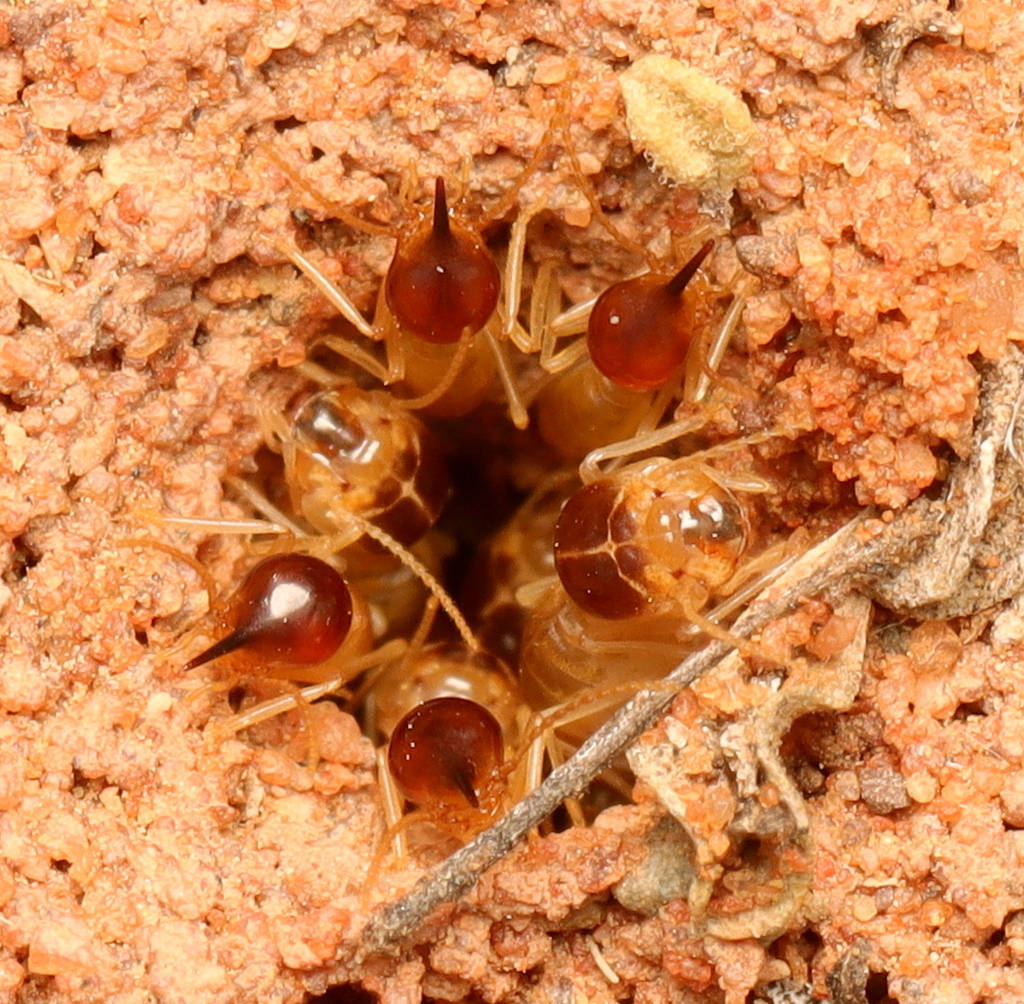
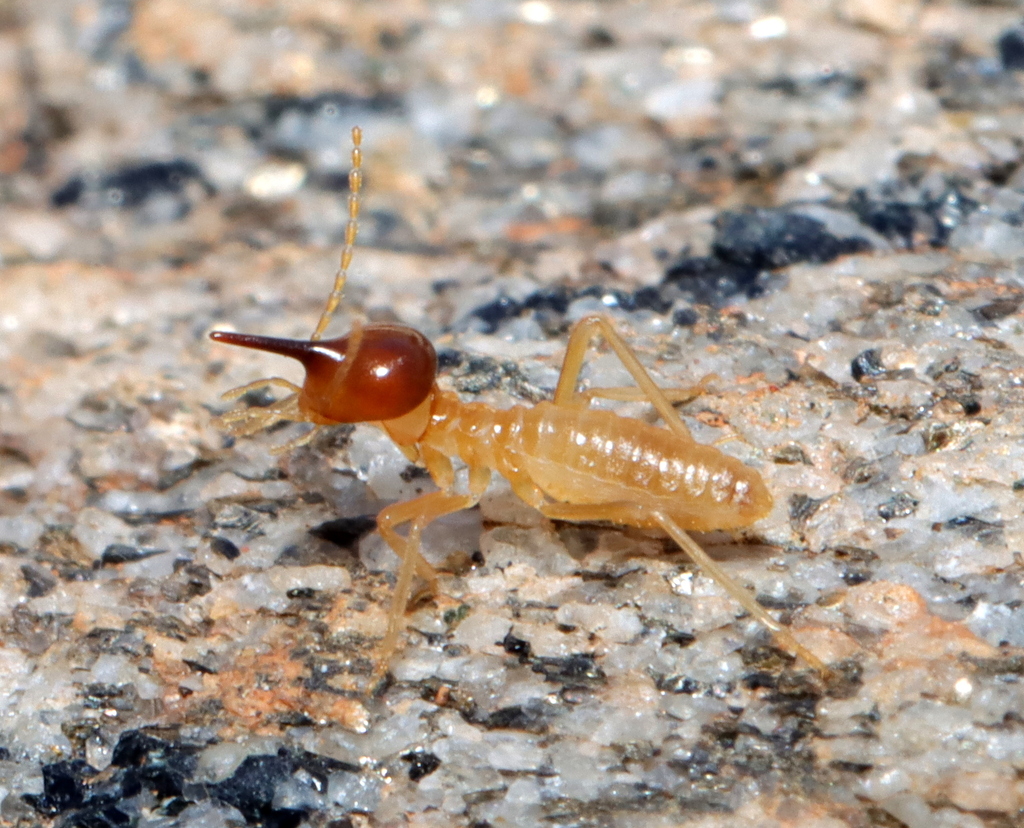
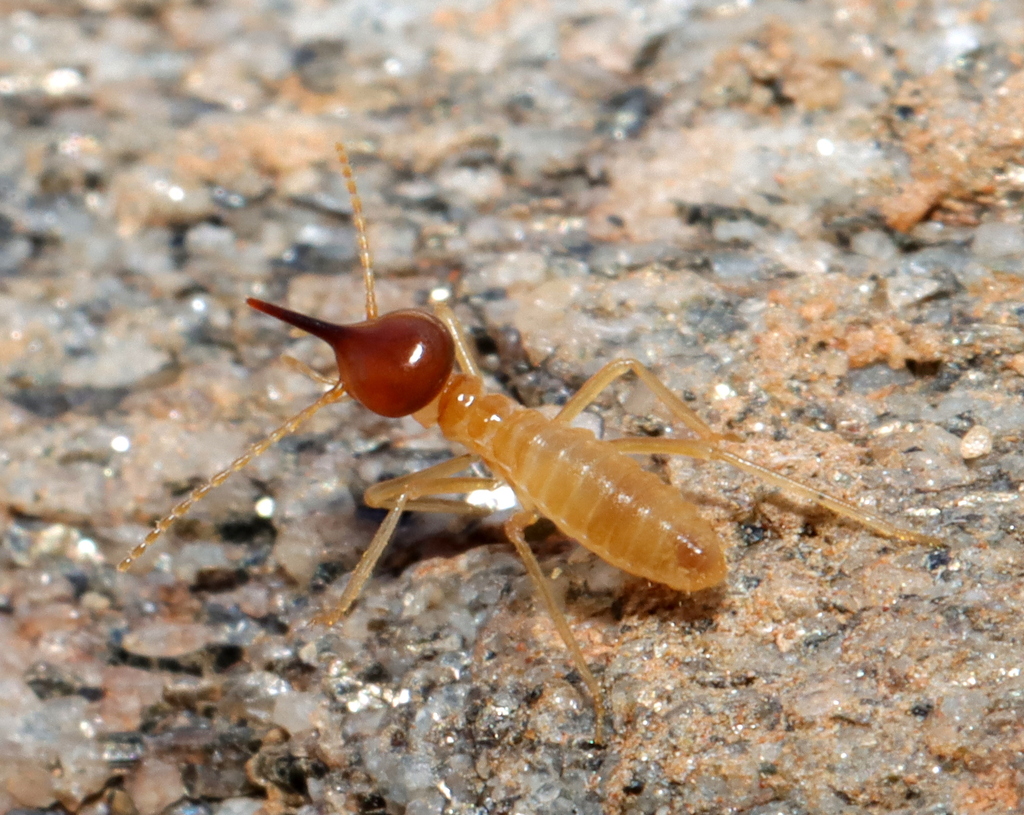
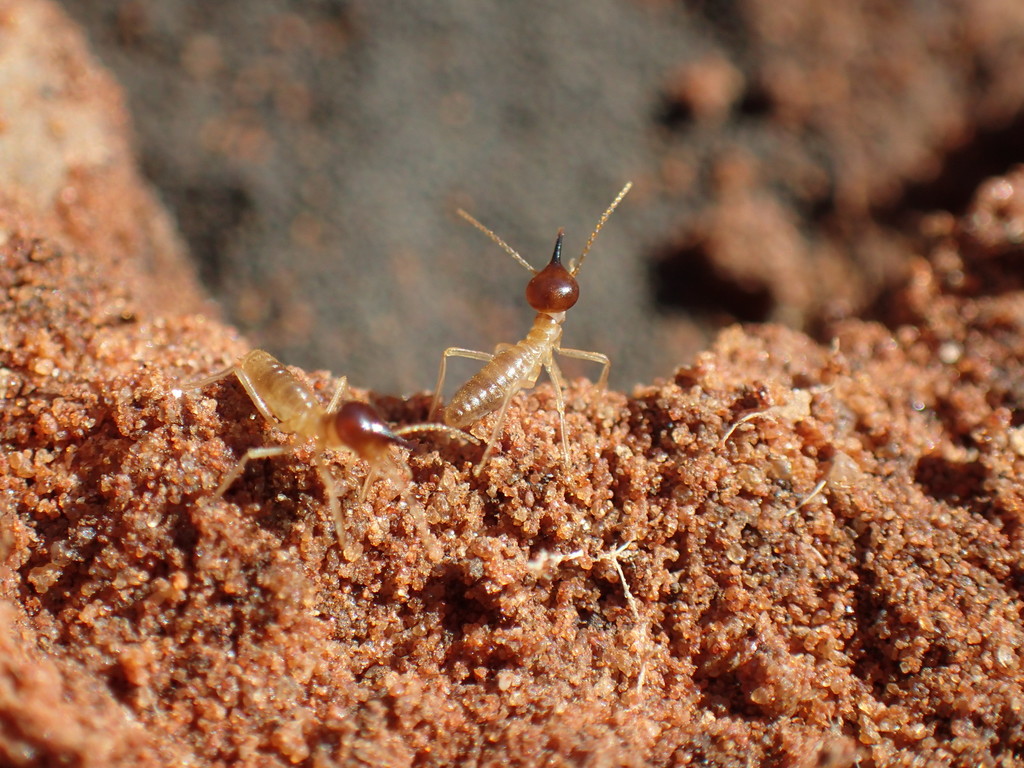
Monotypic. The nasus is very slender and cylindrical, at most slightly tapering; the reduced mandibles have no apical process; the head capsule is not constricted; there are 12–14 antennal segments, usually 14. The hair pits of the minute setae are clearly visible as pale spots over the whole head capsule, including the nasus.
This genus is monotypic, containing only this species; the following is the genus-level description based on the original literature; species-level measurements and intraspecific variation are given in the original.
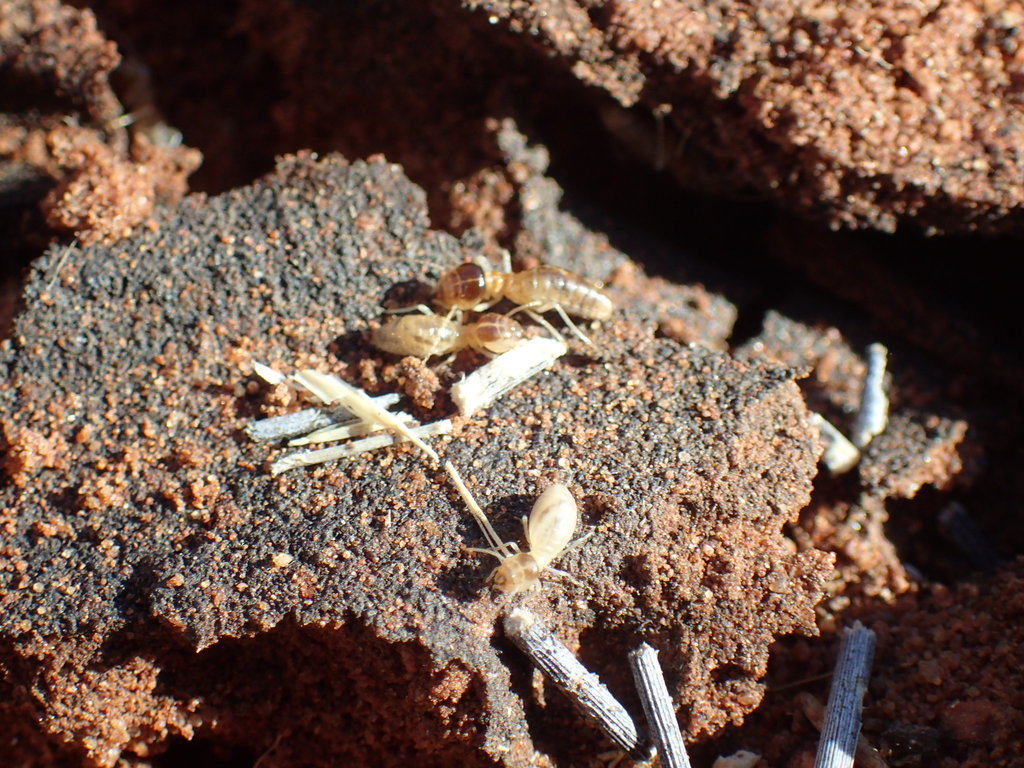
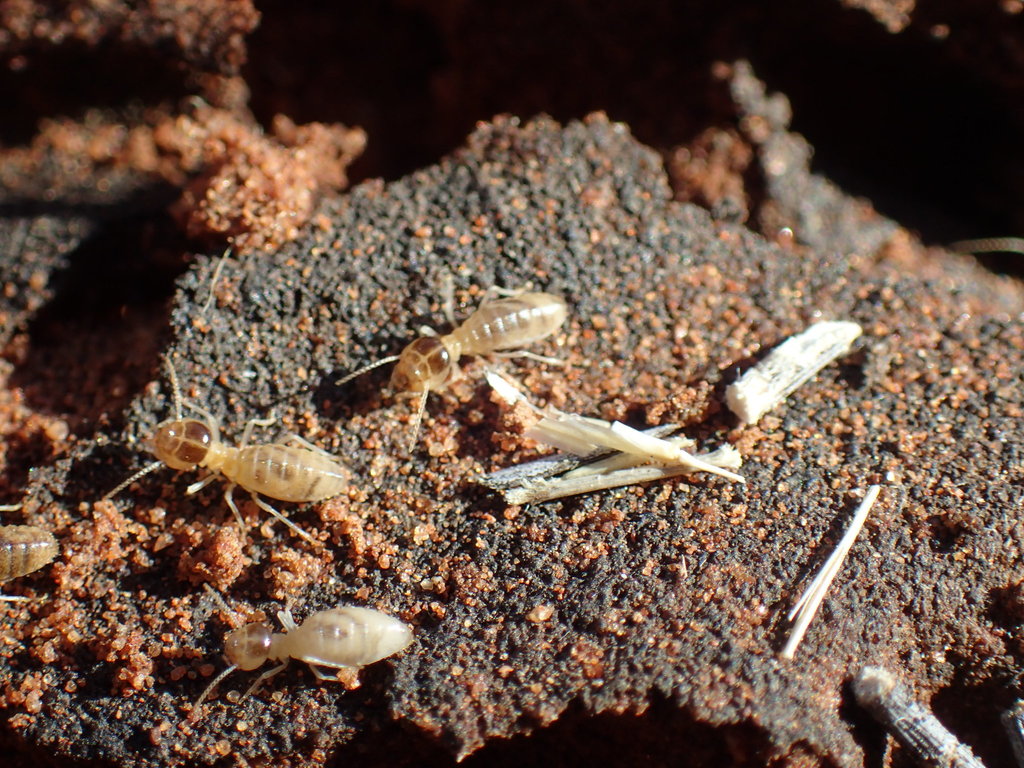
Photos 8 photos
Freely licensed photos, click to enlarge. Hotlinked from iNaturalist / Wikimedia Commons; the rights stay with the photographers — author, licence and source page are shown under each photo. Only the first 6 are shown here; the rest are under “All photos” at the end of the page.
Distribution map
Aggregated from GBIF occurrence records on a 1° grid; only extant taxa of this checklist are used, so fossil records are excluded. Dot size and shade show the number of records inside a cell.
Related papers
Cached papers for this genus (matched automatically, for reference); to search this species with its junior synonyms merged in, use the literature search.
- The Foraging Tunnel System of the Namibian Desert Termite,Baucaliotermes hainesi
Abstract
The harvester termite, Baucaliotermes hainesi (Fuller) (Termitidae: Nasutitermitinae), is an endemic in southern Namibia, where it collects and eats dry grass. At the eastern, landward edge of the Namib Desert, the nests of these termites are sometimes visible above ground surface, and extend at least 60 cm below ground. The termites gain access to foraging areas through underground foraging tunnels that emanate from the nest. The looseness of the desert sand, combined with the hardness of the cemented sand tunnels allowed the use of a gasoline-powered blower and soft brushes to expose tunnels lying 5 to 15 cm below the surface. The tunnels form a complex system that radiates at least 10 to 15 m from the nest with cross-connections between major tunnels. At 50 to 75 cm intervals, the tunnels are connected to the surface by vertical risers that can be opened to gain foraging access to the surrounding area. Foraging termites rarely need to travel more than a meter on the ground surface. The tunnels swoop up and down forming high points at riser locations, and they have a complex architecture. In the center runs a smooth, raised walkway along which termites travel, and along the sides lie pockets that act as depots where foragers deposit grass pieces harvested from the surface. Presumably, these pieces are transported to the nest by a second group of termites. There are also several structures that seem to act as vertical highways to greater depths, possibly even to moist soil. A census of a single nest revealed about 45,000 termites, of which 71% were workers, 9% soldiers and 6% neotenic supplementary reproductives. The nest consisted of a hard outer "carapace" of cemented sand, with a central living space of smooth, sweeping arches and surfaces. A second species of termite, Promirotermes sp. nested in the outer carapace.
- The ecology and foraging behaviour of the harvester termite, Baucaliotermes hainesi in semi-arid grasslands in the northwestern interior of South Africa
Abstract
- Psammolepisma schultzei
Abstract
Psammolepisma schultzei (Silvestri, 1908) Ctenolepisma schultzei Silvestri 1908f: 294. Type data: holotype (2 slides) MUSA; paratypes (alcohol) MUSA, 1♂ 3♀♀ 1 unsexed (in poor condition, alcohol) ZMH. Type locality: South Africa, Steinkopf. Psammolepisma schultzei (Silvestri).— Irish 1988c: 34 [redescr. based on syntypes as well as seven additional samples from Hohedun, Namibia and Cape Province, Gemsbokvlakte, South Africa (6 in NMNW (all probably desiccated, Irish 2018: 22), 1 NCIP)]. Distribution. Namibia, South Africa (Cape Province) Ecology. Semi-desert, under dry grass clumps on dunes. One specimen from a nest of Baucaliotermes hainesi (Fuller, 1922) [Termitidae] but not obligate nidicole.
Papers on this species, synonyms included → OpenAlex Google Scholar CNKI
Abstracts come from open metadata; copyright remains with the original authors/publishers. For reference only — please check the original.
Literature notes
Edited notes based on the original literature, not transcriptions. The source markers in each paragraph point to archived records in .sources; full citations are listed below.
Subterranean foraging tunnels in the Namib Desert
According to Tschinkel's (2010) study of Baucaliotermes hainesi in the NamibRand Nature Reserve, Namibia, this species forages along subterranean tunnels: the nest often protrudes as a mound 10–15 cm high and extends at least 60 cm below ground; the tunnels lie 5–15 cm below the surface, are lined with cemented sand and radiate at least 10–15 m from the nest, with cross tunnels linking the main ones; every 50–75 cm (SD 14–40 cm) a vertical riser opens to the surface, and the risers are closed during the day, so foragers rarely walk more than 0.5–1 m above ground; in cross-section each tunnel has a smooth raised central walkway flanked by depots where grass fragments collected on the surface are temporarily stored.
The same study dissected one nest and counted about 45,000 termites: roughly 32,300 workers (71%, 36 g dry mass), 4,100 soldiers (9.1%, 3 g), 2,800 immature reproductives with wing buds (6.2%, 5 g) and about 6,000 immatures (13%); no primary reproductives and no royal cell were found, so the authors suggest the dissected nest may have been a satellite nest. The nest consists of a cemented sand carapace and a smooth vaulted inner layer, and the grass fragments inside weighed about 15 g in total, of which about 10.5 g lay in the 10–20 cm layer; the species feeds on dry grass and is restricted to southern Namibia and the north-western Cape Province of South Africa.
References
Cite this species
Citation strings are generated from the fields of this page; please keep the DOI and the version number when citing.
GB/T 7714
班奈特格林. Extant Isoptera (termites): a checklist of Latin and Chinese names: Baucaliotermes hainesi 海恩斯细颈白蚁[EB/OL]. Version 2026.10.30. https://termite-extant-isoptera.org/en/species/baucaliotermes-hainesi/. DOI: 10.5281/zenodo.23646836.
BibTeX
@misc{isoptera_baucaliotermes_hainesi_2026,
  author       = {班奈特格林},
  title        = {Baucaliotermes hainesi: a checklist of extant Isoptera (termites)},
  year         = {2026},
  version      = {2026.10.30},
  howpublished = {https://termite-extant-isoptera.org/en/species/baucaliotermes-hainesi/},
  note         = {TERMITIDAE; version 2026.10.30; DOI: 10.5281/zenodo.23646836},
  doi          = {10.5281/zenodo.23646836}
}
RIS
TY  - ELEC
TI  - Baucaliotermes hainesi: a checklist of extant Isoptera (termites)
AU  - 班奈特格林
PY  - 2026
UR  - https://termite-extant-isoptera.org/en/species/baucaliotermes-hainesi/
DO  - 10.5281/zenodo.23646836
ER  -