Subfamily Crepititermitinae · 响白蚁亚科
Filter the taxa recorded under this subfamily by name and locality; for the whole site use the full-text search.
Distribution map
About the subfamily
The subfamily Crepititermitinae was established by Hellemans, Engel, and Bourguignon in 2024 (21), with the type genus Crepititermes Emerson, 1925. The subfamily name is derived from the type genus name (Latin crepitus, a cracking sound). This checklist records 1 genera and 1 species.
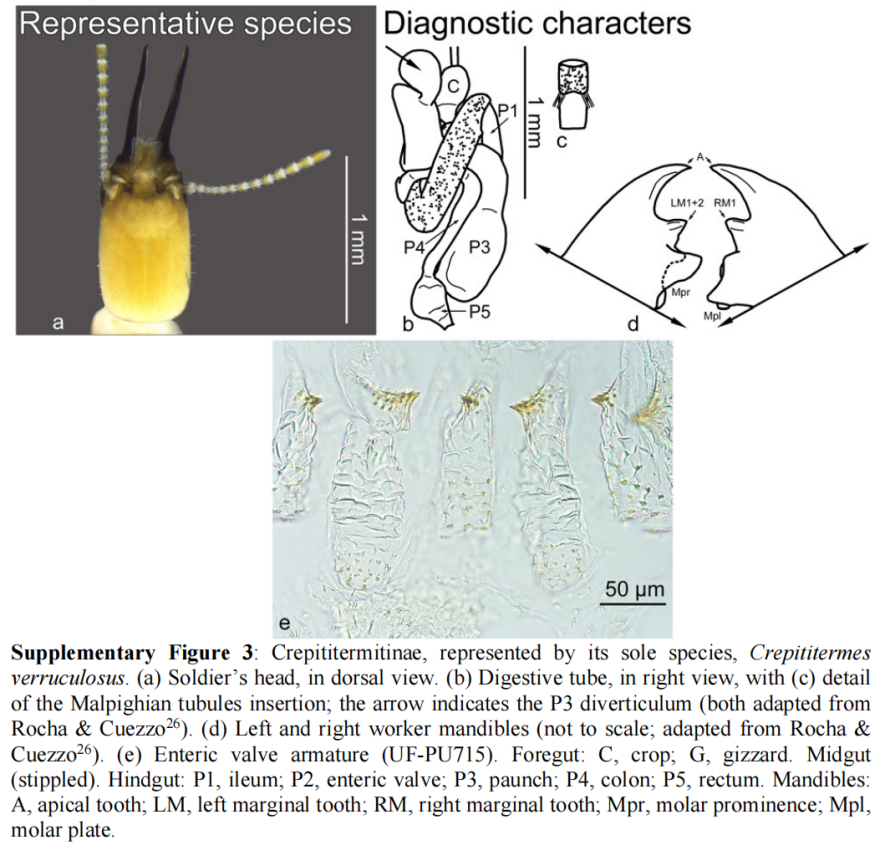
Because it contains only one genus and one species, its characters are those of the subfamily. The single species is distributed in South America: Brazil, Colombia, French Guiana, Guyana, Bolivia, Ecuador, Paraguay, Peru, and Trinidad and Tobago. Its diet is humus (soil). The soldier head is nearly rectangular with a flat frons; the labrum has a concave apical margin and sharp lateral angles, and the mandibles are symmetrical snapping mandibles. Its workers defend themselves by autothysis (21): when disturbed, the dorsal body wall ruptures at the junction of the thorax and abdomen, exposing the sticky gut contents to repel enemies. Characters such as a hindgut P3 with a caecum and a gizzard with a columnar belt place it between the Cubitermitinae and related groups, making it one of the representative early-branching groups of the higher termites.
Rocha & Cuezzo (2015) (45) first systematically described the morphology and in situ coiling of the worker digestive tract of this species; the alate was previously described by Emerson (1925) from the holotype from Kartabo, Guyana (the holotype of Crepititermes verruculosus is itself an imago), and Roonwal & Verma (1980) (46) further described the fine microsculpture of its wing surface. The worker gut metagenome of the Petit Saut population in French Guiana has also been sequenced (Mikaelyan et al., 2015) (47), providing material for the study of gut symbionts of soil-dwelling higher termites.
This section is the standing account the site maintains for this rank and is updated on this page as the classification is revised; the checklist index is in the Checklist.
Genus (1)
- Crepititermes 响白蚁属 1 species
Parent level: Checklist index · Termitidae 白蚁科 · Data & downloads