Termite Basics: Morphology
← Back to the Basics index.
This page lists the parts of a termite that can actually be seen and counted: the Chinese name used on this site, the Latin/English term, the caste in which it occurs, and what to look for. Entries are compiled from the archived volumes of Fauna Sinica, Insecta Vol. 17, Isoptera (Huang Fusheng et al., 2000), Termitology (Cheng Dongbao & Yang Zhaofen, 2014), Biology of Termites: A Modern Synthesis and Krishna et al. (2013), Treatise on the Isoptera of the World. Terminology follows the site glossary (_data/translation_glossary.yml) so that it matches the checklist and the morphological descriptions on the family, genus and species pages.
Termites are front-headed (prognathous) insects with chewing mouthparts, divided into head, thorax and abdomen. Adults are usually a few millimetres to just over a centimetre long; alates reach 10–30 mm including the wings; a long-lived queen, with her abdomen enormously distended, may reach 60–70 mm, and a few African species exceed 100 mm. Castes of the same species differ so much that every description must state which caste is being described — the reason identification keys are always split into alates and soldiers.
This page covers external morphology and the main internal organs only; names and distributions of taxa are in the checklist, and identification runs through the morphological descriptions on the family, genus and species pages; where a species text has not yet been checked, the page gives the original description citation and links to its genus page. The site has withdrawn the Fauna Sinica family and genus keys; only the order and Termitidae subfamily key on the checklist and the world genus key on the Kalotermitidae page remain.
- 1. Castes
- 2. Head
- 3. Thorax, wings and legs
- 4. Abdomen
- 5. Soldier-specific structures
- 6. Internal organs
- 7. Using these terms with descriptions and keys
- 8. Names, synonyms and sources
1. Castes
Two large groups are recognised by function first: the reproductive and the non-reproductive castes. Within them the castes are separated by developmental origin — the same name may arise along different routes in different groups (supplementary reproductives especially), so read the table with both form and developmental origin in mind.
| Group | Caste | Form and development |
|---|---|---|
| Non-reproductive | white immature | White, unsclerotised, without soldier features; fed by nestmates. Those without external wing buds are white larvae, those with them white nymphs |
| Non-reproductive | larva (dependent larva) | No external wing buds, cannot feed itself; darker and older than the white larva, with no sharp boundary — calling the white larva a larva is also correct and widely accepted |
| Non-reproductive | pseudergate (false worker) | Feeds itself; wing buds shortened or gradually lost; develops from the larva or by regressive moult from the nymph; in groups without true workers (Kalotermitidae etc.) it is the main workforce |
| Non-reproductive | worker | Develops along the wingless route; wingless (wing buds occur as rare abnormalities), eyes strongly reduced; some species have size and sex castes among workers |
| Non-reproductive | presoldier | Soldier-like head but unpigmented and weakly sclerotised, cannot defend; an instar on the way to the soldier from other castes |
| Non-reproductive | soldier | Head heavily sclerotised; mandibles enlarged (mandibulate) or the head drawn out into a nasus with reduced mandibles (nasute); cannot moult or reproduce, cannot feed itself; some species have size and sex castes among soldiers |
| Non-reproductive | nymph | Immature with external wing buds that grow with age; normally develops into the alate |
| Reproductive | alate | Two complete wing pairs, dark, compound eyes and ocelli well developed; wings break off at the wing scale after the dispersal flight |
| Reproductive | dealate | Wings shed, scales retained; pairing after the flight makes it a primary reproductive |
| Reproductive | primary reproductive (king, queen) | From a dealate pair founding a nest; pigmented, eyes well developed, wing scales present; in many species the queen becomes physogastric with exposed intersegmental membranes |
| Reproductive | adultoid | Resembles the primary reproductive; developed from an alate that did not fly and shed its wings inside the nest, mostly in Termitidae |
| Reproductive | neotenic: brachypterous, squamate, apterous | Wing buds present and growing, classed as long-, short- and micro-brachypterous; those that have shed the wings and keep only scales are squamate; wingless forms are apterous; they do not fly and replace the primary king and queen in the nest |
| Reproductive | neotenic: larvoid, pseudergatoid, nymphoid, ergatoid, reproductive soldier | In groups without true workers, larvoid (from larvae) and pseudergatoid (from pseudergates); in groups with true workers, nymphoid (from nymphs, wing buds retained) and ergatoid (from workers, no wing buds); the reproductive soldier is known only in Archotermopsidae |
Castes are not a fixed ladder but branches split by developmental route. Termites have three kinds of moult — progressive, stationary and regressive — and the last returns the individual to an earlier instar. In one-piece nesters (Kalotermitidae etc.) a pseudergate can moult progressively into a nymph, presoldier or neotenic, or hold its form by a stationary moult, while a nymph can regress to a pseudergate. The larva of Mastotermes darwiniensis may reach the alate through a nymph or become a worker or presoldier directly. In the remaining, multiple-piece nesters the larva takes one of two routes: the nymphal line leads to alates, nymphoid and adultoid reproductives, the wingless line to workers, presoldiers and soldiers, and a worker can still become an ergatoid.
Castes also diversify within themselves. Hospitalitermes medioflavus has three worker forms and one soldier form: minor workers are all male, medium and major workers all female; minor workers pass through a presoldier to become soldiers and medium workers can grow into major workers; major workers only carry food, minor workers gather lichens, soldiers scout and defend. Macrotermes soldiers are major and minor; M. annandalei and M. barneyi keep major and minor workers in the same nest. Supplementary reproductives differ between groups and even within a genus: most Termitidae produce them, Macrotermes bellicosus has adultoids while M. subhyalinus has none, Odontotermes obesus produces them while O. assmuthi does not; whether O. formosanus can produce them has long been debated, and most authors think not.
Neotenic reproductives carry two parallel nomenclatures: one by wing development (brachypterous, squamate, apterous), one by source caste (larvoid, pseudergatoid, nymphoid, ergatoid, reproductive soldier). The two are not exclusive — nymphoids usually keep wing buds, ergatoids have none, squamates have lost the buds and keep only scales — and papers often give only one set, so check which is meant.
2. Head
The head capsule is round, oval, square or pear-shaped and prognathous. Its most conspicuous feature is the epicranial suture: a transverse (ecdysial) line and a median longitudinal line meeting in a T or Y. Many species show it only faintly. The area in front of the transverse line is the frons; behind it lies the vertex, and behind that the occiput. In Rhinotermitidae and Termitidae the junction of the two lines is often depressed or raised and opens as the fontanelle, the opening of the frontal gland and one of the hallmarks of Neoisoptera.
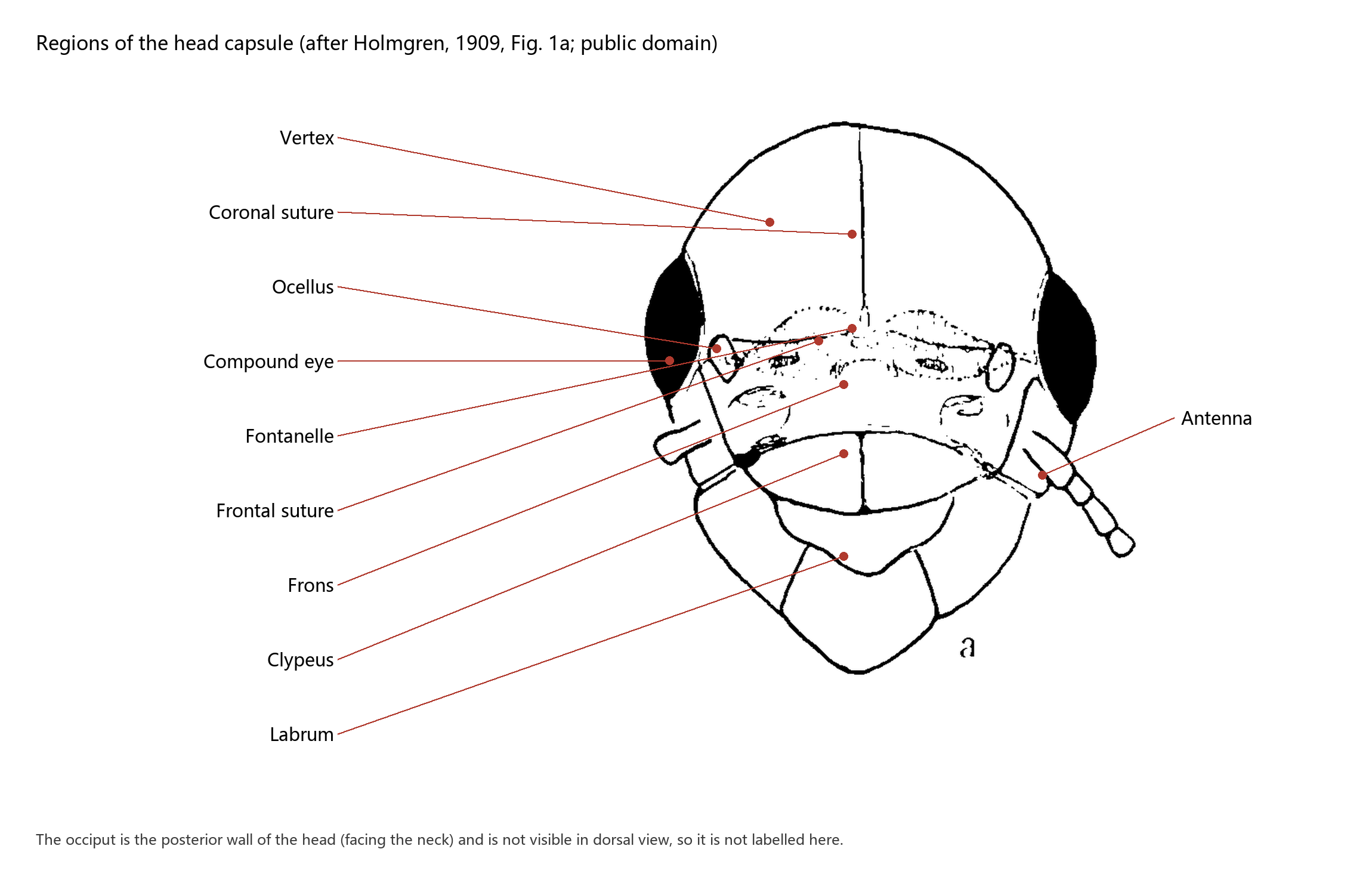
The compound eyes sit on the sides of the head. They are large in alates — about 200 ommatidia per eye in Mastotermes, 300–400 in Coptotermes formosanus and about 360 in Odontotermes formosanus — and reduced to a pigment patch or lost entirely in workers and soldiers. The single pair of ocelli lies above or anterodorsally to the compound eyes, whitish and translucent; they occur only in reproductives, and are missing even there in a few groups.
Antennae are moniliform or oval with 9–30+ segments; beyond the scape and pedicel, the third segment is often split, producing an “incomplete division” that must be allowed for when counting.
Mouthparts are of the chewing type: the labrum covers the mouth; the clypeus is divided into a soft anteclypeus and a sclerotised postclypeus (often with a median groove in Rhinotermitidae and Termitidae); the paired mandibles carry an apical tooth, marginal teeth and a basal molar plate; each maxilla has a cardo, stipes, galea, lacinia and a 5-segmented palp; the labium has a postmentum, prementum, glossa, paraglossa and 3-segmented palps. The mouth cavity is enclosed by the labrum, mandibles, maxillae and labium, with the hypopharynx forming its floor.
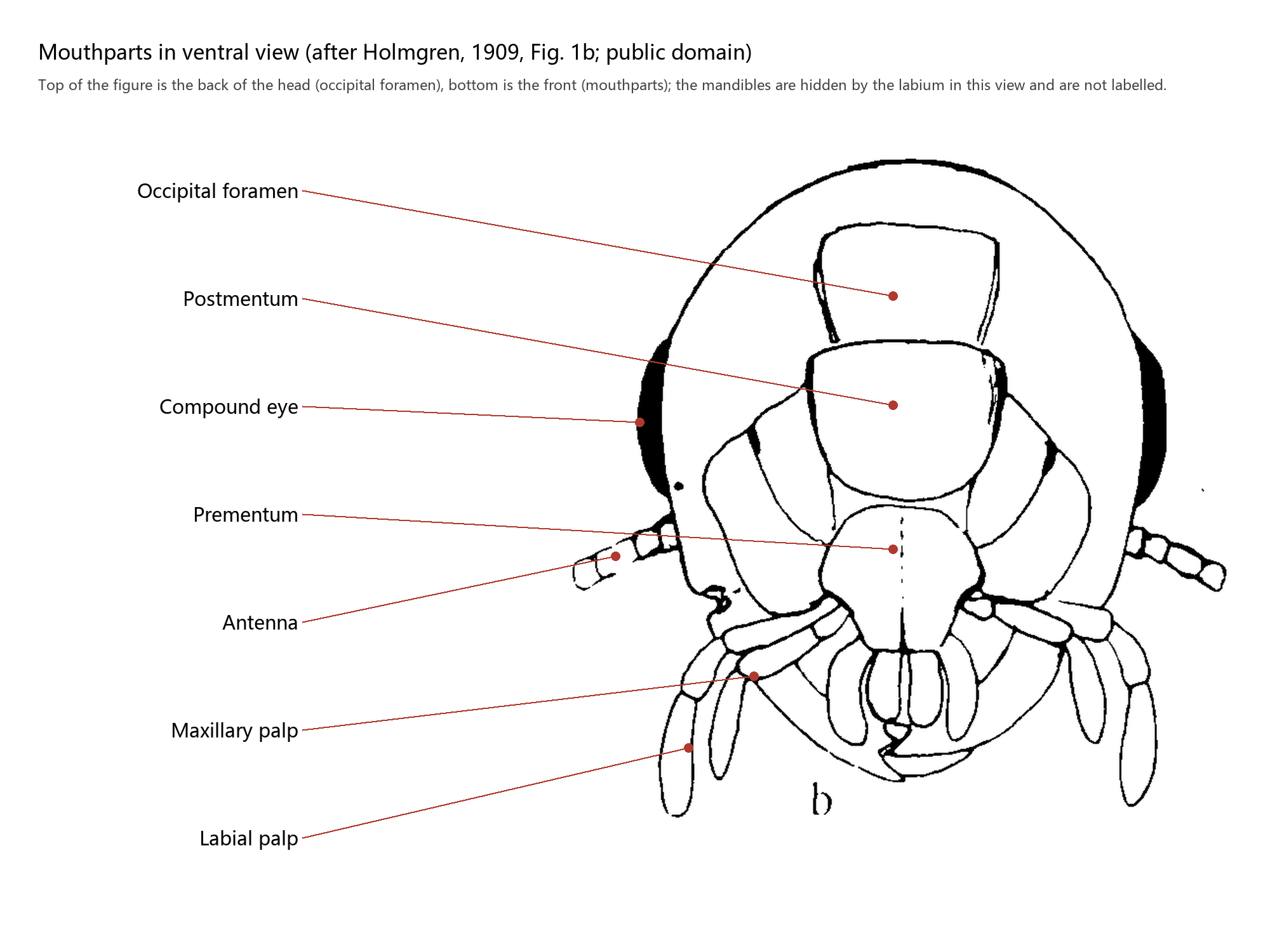
| Name | Latin / English | Notes |
|---|---|---|
| Head capsule | head capsule | The whole head skeleton; soldier head shape (square, oblong, pear-shaped, conical) is widely used in genus keys |
| Epicranial suture | epicranial suture | Transverse and longitudinal lines, T- or Y-shaped; the median line runs forward over the vertex |
| Frons | frons | Central area in front of the transverse line; in nasute soldiers the frons is drawn out as the nasus |
| Vertex | vertex | Dorsal area between the transverse line and the occiput |
| Occiput | occiput | Rear of the head; the occipital foramen transmits the neck, nerve cord and gut |
| Occipital foramen | occipital foramen | The large posterior opening of the head |
| Gena | gena | Lateral area below and behind the compound eye; often expanded or toothed in soldiers |
| Compound eye | compound eye | Made of ommatidia; large in alates, reduced or absent in workers and soldiers |
| Ocellus | ocellus | One pair, above or anterodorsal to the compound eyes; usually only in reproductives |
| Antenna | antenna | Moniliform; 9–30+ segments, fewer in soldiers |
| Scape | scape | First antennal segment, the stoutest |
| Pedicel | pedicel | Second antennal segment |
| Flagellum | flagellum | Segment 3 onward; segment 3 is often split |
| Antennal socket | antennal socket | Membranous pit on the frons where the antenna articulates |
| Labrum | labrum | Front flap of the mouthparts, tongue-shaped; soldier labrum may be tongue-shaped, bifid, asymmetric or grooved |
| Clypeus | clypeus | Sclerite above the labrum, divided into ante- and postclypeus |
| Anteclypeus | anteclypeus | Anterior, membranous part of the clypeus |
| Postclypeus | postclypeus | Posterior, fully sclerotised part; often grooved in Rhinotermitidae and Termitidae |
| Epipharynx | epipharynx | Inner (labral) wall of the mouth, bearing regular small spines |
| Mandible | mandible | Paired, with anterior and posterior articulations; apical tooth, marginal teeth and molar plate |
| Apical tooth | apical tooth | The terminal tooth; the reference point for the mandibular index |
| Marginal tooth | marginal tooth | Teeth on the inner mandibular edge, numbered 1, 2 … from the apex |
| Molar plate | molar plate | Basal grinding surface of the mandible, often ridged |
| Left mandibular index | left mandibular index | Distance from apical tooth to first marginal tooth ÷ distance from first to second marginal tooth; a standard measurement |
| Mandibular dentition | mandibular dentition | Number and arrangement of teeth; often asymmetric in soldiers, with more teeth on the left |
| Maxilla | maxilla | Paired; cardo, stipes, galea, lacinia and maxillary palp |
| Cardo | cardo | Basal segment articulating with the head |
| Stipes | stipes | Main body of the maxilla |
| Galea | galea | Flattened, two-segmented lobe covering the lacinia laterally |
| Lacinia | lacinia | Inner lobe with two apical teeth and a row of spiniform setae |
| Maxillary palp | maxillary palp | Five segments, inserted on the stipes |
| Labium | labium | Postmentum, prementum, glossae, paraglossae and labial palps; forms the rear wall of the mouth |
| Postmentum | postmentum | Formerly called gula; elongated in soldiers and its shape follows the head shape — a genus-level character |
| Prementum | prementum | Bears the glossae, paraglossae and labial palps |
| Glossa | glossa | Inner pair of apical lobes of the prementum |
| Paraglossa | paraglossa | Outer pair of apical lobes of the prementum |
| Labial palp | labial palp | Three segments |
| Hypopharynx | hypopharynx | Floor of the mouth; sensory and food-transporting |
| Mouth | mouth | Cavity enclosed by labrum, mandibles, maxillae and labium, leading to the cibarium and pharynx |
| Cibarium | cibarium | Cavity between mouth and pharynx, start of the foregut |
| Fontanelle | fontanelle | Opening of the frontal gland at the epicranial junction or on the frons; absent in most lower groups, present in Rhinotermitidae and Termitidae |
| Frontal gland | frontal gland | Sac-like gland in the head, defensive; nasute soldiers eject its secretion |
| Tentorium | tentorium | Internal head skeleton for muscle attachment; its pits mark the head surface |
| Neck | cervix | Short membranous region between head and thorax |
3. Thorax, wings and legs
The thorax has three segments: pro-, meso- and metathorax. The pronotum is free and shield-like, and highly variable — transverse-rectangular, semicircular, trapezoidal, or saddle-shaped with the front raised and the sides deflexed; its front and rear margins are often notched. The meso- and metanota are associated with the pterothorax. The prosternum is reduced; the mesosternum is the most developed and roughly triangular. Anterior and posterior notal wing processes connect to the wing base through the axillary sclerites.
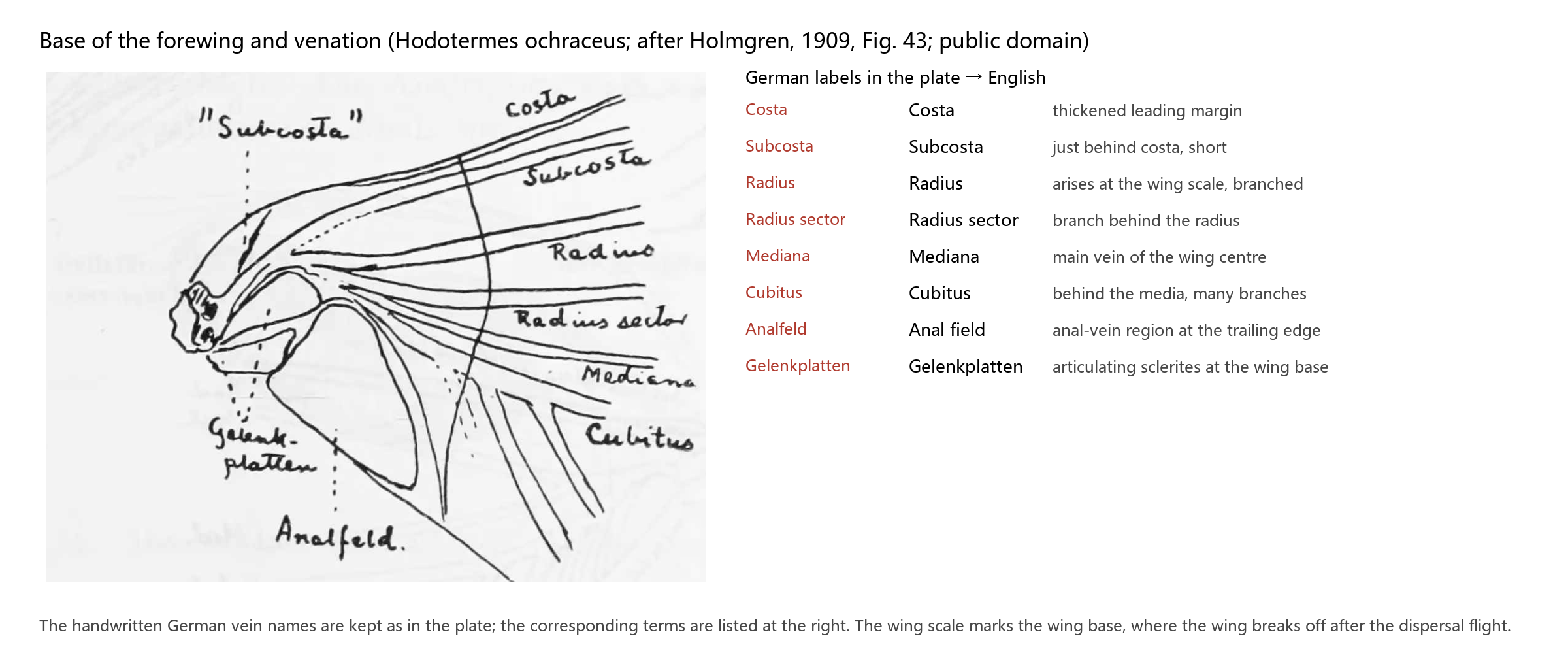
There are two pairs of membranous, elongate wings, folded flat over the abdomen at rest, the forewing usually a little longer than the hindwing — hence “Isoptera”, although they are not truly equal. Wing vestiture differs by family: wings are bare (or with microtrichia only) in Mastotermitidae, Kalotermitidae and Hodotermitidae, hairy in Coptotermes. Mastotermitidae and Hodotermitidae have a reticulate membrane with fine cross-veins; only Mastotermitidae have a large anal lobe on the hindwing. After the dispersal flight the wings break off along the humeral (basal) suture, leaving triangular wing scales: the forewing scale is distinctly larger than the hindwing scale in Kalotermitidae and Rhinotermitidae, but about equal in Termitidae.
The three pairs of legs have short coxae and trochanters and long femora and tibiae; the tibia bears a row of stout spines laterally and 2–3 apical spurs, summarised as the tibial spur formula (3:3:3, 3:2:2, 2:2:2 …). The tarsus is usually 4-segmented; 5 in Mastotermitidae, 5 ventrally but 4 dorsally in Archotermopsidae (tarsomere 2 reduced and visible only ventrally), and 3 in Stylotermes and Indotermes. The pretarsus ends in a pair of curved claws; some Kalotermitidae have an arolium.
| Name | Latin / English | Notes |
|---|---|---|
| Prothorax | prothorax | First thoracic segment; pronotum free |
| Mesothorax | mesothorax | Second thoracic segment; bears forewings and mid legs |
| Metathorax | metathorax | Third thoracic segment; bears hindwings and hind legs |
| Pterothorax | pterothorax | Meso- plus metathorax, specialised for flight |
| Pronotum | pronotum | Free shield; shape (rectangular, semicircular, trapezoidal, saddle-shaped) and setae are genus/species characters |
| Mesonotum | mesonotum | Separated from the pronotum, close to the metanotum |
| Metanotum | metanotum | Last thoracic notum |
| Tergum / notum | tergum / notum | Dorsal plate of a segment |
| Pleuron | pleuron | Lateral plate of a segment |
| Sternum | sternum | Ventral plate; prosternum reduced, mesosternum triangular |
| Anterior notal wing process | anterior notal wing process | Anterior wing articulation on the pterothoracic notum |
| Posterior notal wing process | posterior notal wing process | Posterior wing articulation |
| Axillary sclerites | axillary sclerites | Small plates linking wing base to the notal processes |
| Wing | wing | Membranous, two pairs; fore- and hindwing similar in shape and venation |
| Forewing | forewing | On the mesothorax; usually slightly longer |
| Hindwing | hindwing | On the metathorax; anal lobe large only in Mastotermitidae |
| Anal lobe | anal lobe | Expanded posterior hindwing area, well developed in Mastotermitidae |
| Humeral (basal) suture | humeral suture / basal suture | The break line along which the wing is shed |
| Wing scale | wing scale | Triangular wing base left after shedding; fore/hind scale ratio separates families |
| Costa | costa (C) | Anterior marginal vein |
| Subcosta | subcosta (Sc) | Vein behind the costa |
| Radius | radius (R) | Median longitudinal vein; fused with Rs in Rhinotermitidae and Termitidae |
| Radial sector | radial sector (Rs) | Branch of the radius; many branches in Kalotermitidae |
| Media | media (M) | Variable in origin (from R, from Cu, or independent) |
| Cubitus | cubitus (Cu) | Posterior longitudinal vein, richly branched, thick basally |
| Anal vein | anal vein (A) | Vein of the anal area; usually lost in Rhinotermitidae and Termitidae |
| Cross-vein | cross-vein | Short vein connecting longitudinals; membrane reticulate in Mastotermitidae and Hodotermitidae |
| Wing microsculpturing | microsculpturing | Under SEM: papillae, tubercles and peg-like projections, plus short hairs |
| Coxa | coxa | First leg segment, articulating with the thorax |
| Trochanter | trochanter | Short segment between coxa and femur |
| Femur | femur | One of the longest leg segments |
| Tibia | tibia | Bears lateral spines and apical spurs |
| Tibial spur | tibial spur | Stout apical spine; its formula separates families |
| Tarsus | tarsus | Composed of tarsomeres; segment count is the first step in family keys |
| Tarsomere | tarsomere | Individual tarsal segment; usually 4, 5 in Mastotermitidae, 3 in Stylotermes and Indotermes |
| Tarsal claw | tarsal claw | Paired curved claws at the tip of the tarsus |
| Arolium | arolium | Pad between the claws; present in some Kalotermitidae |
| Wing pad | wing pad | Wing rudiment of nymphs; may remain short in brachypterous reproductives |
4. Abdomen
The abdomen has 10 segments, cylindrical to olive-shaped, with tergites and sternites joined by membrane so that it can expand — this is how a queen’s abdomen becomes physogastric. Spiracles occur on segments 1–8; sternite 1 is reduced or lost. Tergite 10 tapers and overhangs the anus as the supra-anal plate (epiproct); sternite 10 is paired and divided medially as the paraprocts. In females sternite 7 is enlarged, rounded behind and covers sternites 8 and 9 as the subgenital plate. The male gonopore opens between sternites 9 and 10, and in primitive groups sternite 9 carries a pair of unsegmented styli. A pair of cerci lies beside sternite 10: usually 2 segments, but 5–8 in Mastotermitidae and some primitive taxa. An ovipositor (three pairs of valves) occurs only in female Mastotermitidae.
Reproductives often show brownish patches on the abdomen bearing short, erect yellow secretory setae; their secretion attracts workers to lick it and may play a role in caste formation. The sternal gland lies at the base of sternite 5 in workers of Kalotermitidae, Rhinotermitidae and Termitidae, on sternites 3–5 in Mastotermitidae, and on sternite 4 in Hodotermitidae and Archotermopsidae.
| Name | Latin / English | Notes |
|---|---|---|
| Abdomen | abdomen | 10 segments; tergites and sternites joined by membrane |
| Tergite | tergite | Dorsal abdominal plate; tergites 1–9 similar, transversely rectangular |
| Sternite | sternite | Ventral abdominal plate; sternite 1 reduced or lost |
| Intersegmental membrane | intersegmental membrane | Connects tergites and sternites; exposed in physogastric queens |
| Spiracle | spiracle | One pair on segments 1–8; 6 pairs recorded in fully physogastric queens |
| Supra-anal plate | supra-anal plate (epiproct) | Tergite 10, overhanging the anus |
| Paraproct | paraproct | Sternite 10, paired and divided medially |
| Subgenital plate | subgenital plate | Female sternite 7, enlarged and covering sternites 8–9 |
| Stylus (pl. styli) | stylus (pl. styli) | Paired unsegmented processes on the posterior margin of sternite 9 in lower termites; may occur in both sexes or in one |
| Cercus (pl. cerci) | cercus (pl. cerci) | Paired, beside sternite 10; usually 2-segmented, 5–8 in Mastotermitidae |
| Ovipositor | ovipositor | Only in female Mastotermitidae; three pairs of valves |
| Gonopore | gonopore | Male: between sternites 9 and 10; female: beneath sternite 7 |
| Secretory setae | secretory setae | Short erect yellow setae on the abdomen of reproductives |
| Sternal gland | sternal gland | Trail pheromone source; location varies by family (see above) |
| Tergal gland | tergal gland | Gland beneath the tergites, involved in recognition and aggregation |
| Posterior sternal gland | posterior sternal gland | Hind-abdominal gland active during dispersal and pairing |
| Anus | anus | Opening of the hindgut, between epiproct and paraprocts |
5. Soldier-specific structures
Soldiers are the “soldier plan”: head capsule and mandibles highly specialised, antennal segments often fewer, compound eyes reduced to traces. Two main types are recognised. Mandibulate soldiers have enormous mandibles and a head capsule that does not project forward; the inner teeth of the left and right mandibles often differ, and in some genera (e.g. Capritermes) the mandibles are twisted into a strongly asymmetric “snapping” bite. Nasute soldiers have reduced mandibles and a head drawn out into a long nasus, with the fontanelle opening at its tip and ejecting a sticky secretion (e.g. Nasutitermes). A few genera are intermediate, such as Armitermes, sometimes called nasutoid.
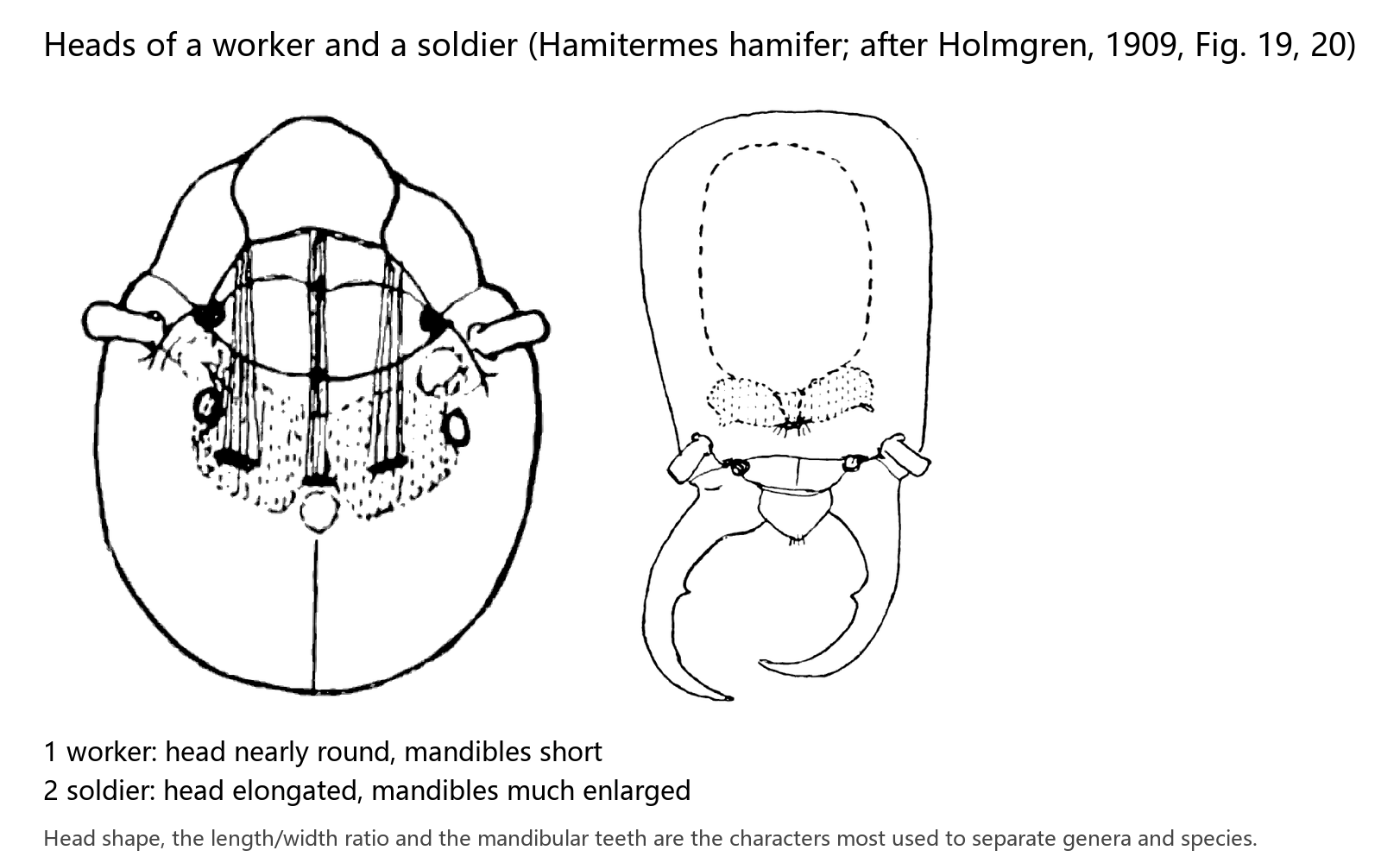
Soldier heads are square, oblong, round, oval, pear-shaped or conical. In Cryptotermes the head is short, thick and raised in front, plugging the gallery opening — phragmosis. The epicranial suture is often Y-shaped or reduced to the median line. The frons may be flat or raised, and in nasute soldiers it becomes the nasus. The fontanelle varies: absent in many lower termites; a large circular pore on the front of the head in Coptotermes, which secretes a milky acidic fluid (hence the Chinese name “milk-exuding termite”); at the nasus tip in Nasutitermes. Labral shape is a standard character: tongue-shaped in lower groups, bifid or asymmetric in Termitidae, and extremely long and grooved in Schedorhinotermes, where it can cover the mandible tips and the groove leads to the fontanelle.
The ratio of pronotal width to head width is also used: the pronotum is wider than or about as wide as the head in Kalotermitidae, slightly narrower in Rhinotermitidae, and much narrower in Termitidae. In Reticulitermes soldiers, the number of setae in the middle of the pronotum separates the “raised-frons” group (more than 20 setae) from the “flat-frons” group (about 10 or none).
| Name | Latin / English | Notes |
|---|---|---|
| Mandibulate soldier | mandibulate soldier | Enlarged mandibles, head not projecting; defence by biting and frontal-gland secretion |
| Nasute soldier | nasute soldier | Mandibles reduced, head produced into a nasus, fontanelle at its tip |
| Nasutoid soldier | nasutoid soldier | Intermediate: mandibles reduced but nasus short |
| Nasus | nasus | Tubular forward extension of the frons in nasute soldiers |
| Phragmosis | phragmosis | Head modified as a plug for the nest opening, as in Cryptotermes |
| Frontal pore | frontal pore | Opening of the frontal gland; at the nasus tip in nasutes |
| Frontal gland | frontal gland | One of the largest soldier glands; secretion may glue, irritate or repel enemies |
| Labral shape | labral shape | Tongue-shaped, bifid, asymmetric or grooved — a genus-level character |
| Postmentum | postmentum | Elongated and widened in soldiers, shaped by the head; often sculptured |
| Head width | head width | The most-used soldier measurement; compared with pronotal width to separate families |
6. Internal organs
The gut has three regions. The foregut comprises the mouth, pharynx, esophagus, crop and proventriculus (gizzard): its chitinous lining bears longitudinal ridges, each with transverse rows of palmate processes carrying 8–10 spines pointing backwards to prevent regurgitation; behind it lies the stomodeal valve. The midgut runs from the stomodeal valve to the Malpighian tubules, lined by columnar and regenerative cells with a brush border, and is enclosed by the peritrophic membrane, a protein mesh that protects the epithelium and acts as an ultrafilter. The hindgut runs from the Malpighian tubules to the anus; its anterior part dilates into the gourd-shaped paunch, thin-walled and housing symbiotic flagellates and bacteria, followed by the colon and rectum with six parallel rectal pads.
In Termitidae the hindgut is further modified: Malpighian tubules are fewer, the proventriculus simplified, midgut caeca lost, and a mixed segment of mid- and hindgut epithelium appears between midgut and P1, with the Malpighian tubules clustered nearby as a Malpighian knot; a sclerotised enteric valve forms between P1 and P3. Hindgut compartments follow Holmgren (1909): the enteric valve is P2, P1 (ileum) precedes it, and P3 (paunch), P4 (colon) and P5 (rectum) follow. In lower termites P3 is the largest compartment and is packed with flagellates; Termitidae lack hindgut flagellates and rely on bacteria; Macrotermitinae and some relatives also cultivate fungus combs.
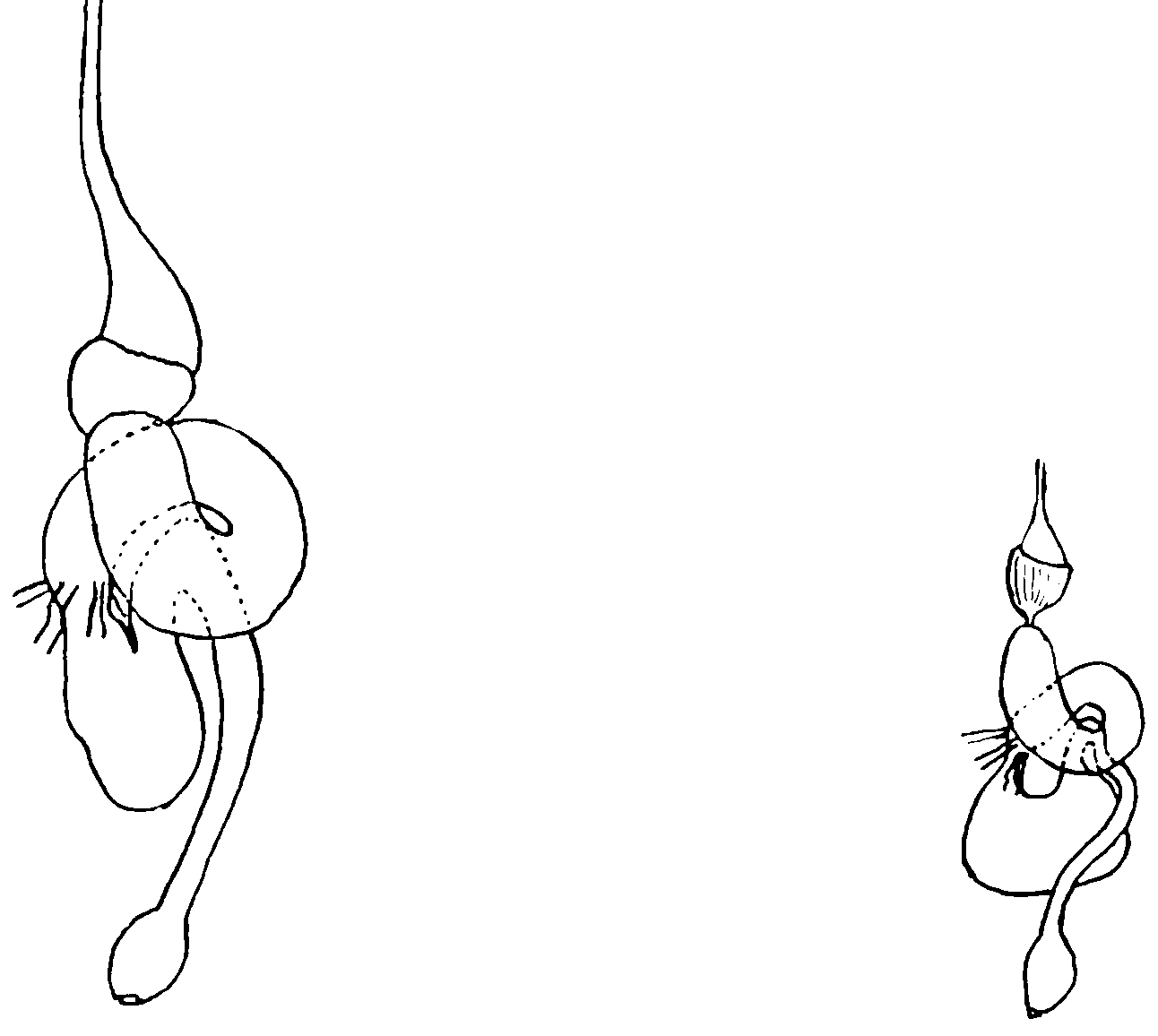
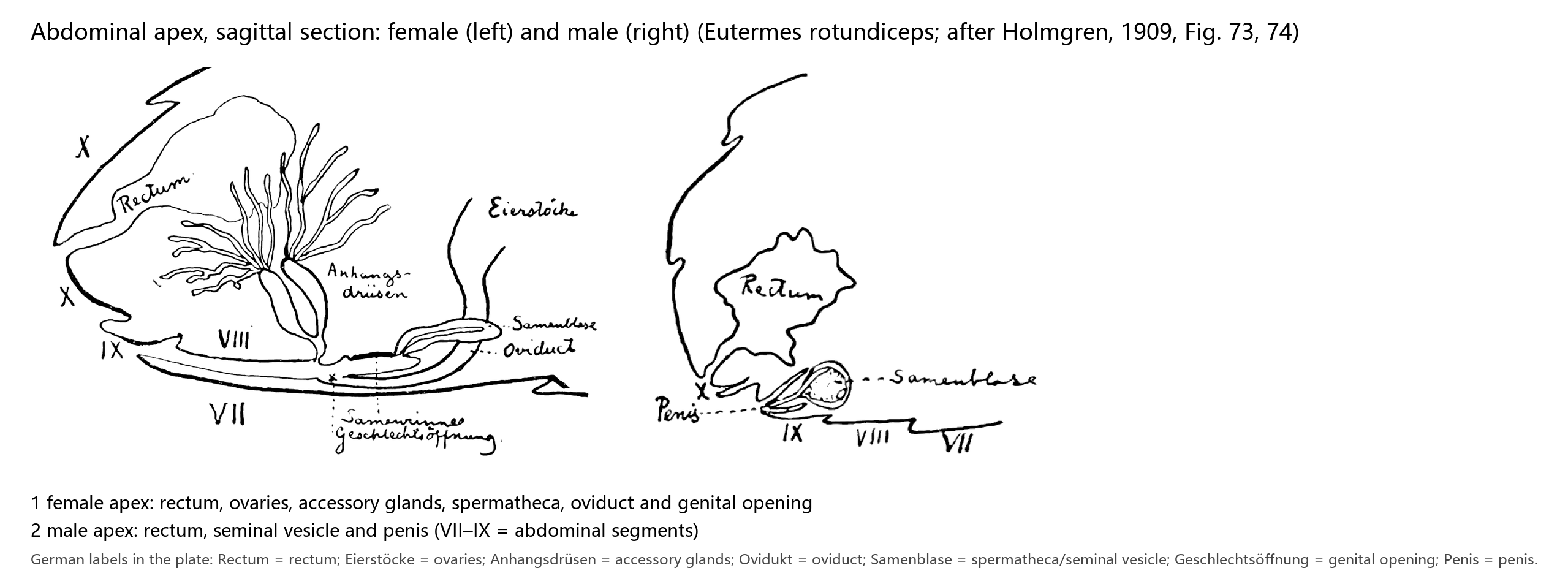
Other internal organs include the brain (proto-, deuto- and tritocerebrum) with the subesophageal ganglion, three thoracic and six abdominal ganglia forming the ventral nerve cord; paired ovaries of many ovarioles (from 7–10 per side in Kalotermitidae to several thousand in Macrotermes), oviducts, spermatheca and vagina; paired testes, vasa deferentia, ejaculatory duct, seminal vesicles and accessory glands; and the frontal, salivary (labial), mandibular, sternal and tergal glands.
| Name | Latin / English | Notes |
|---|---|---|
| Alimentary canal | alimentary canal | Fore-, mid- and hindgut; regional anatomy is used at subfamily level |
| Foregut | foregut (stomodaeum) | Mouth to stomodeal valve, chitin-lined |
| Pharynx | pharynx | Dilated tube behind the mouth, flanked by salivary glands |
| Esophagus | esophagus | Narrow tube from pharynx to proventriculus |
| Crop | crop | Storage region of the foregut, often synonymous with “stomach” |
| Proventriculus (gizzard) | proventriculus (gizzard) | Ridged, with palmate processes and spines; its armature is taxonomically useful |
| Stomodeal valve | stomodeal valve | Valve at the foregut–midgut junction |
| Midgut | midgut (mesenteron) | Stomodeal valve to Malpighian tubules; peritrophic membrane and brush border |
| Midgut caeca | midgut caeca | Pouches at the anterior midgut; usually lost in Termitidae |
| Peritrophic membrane | peritrophic membrane | Protein mesh around the food bolus; protection and ultrafiltration |
| Malpighian tubules | Malpighian tubules | Excretory organs opening at the midgut–hindgut junction |
| Malpighian knot | Malpighian knot | Cluster of tubules near the mixed segment in some Termitidae |
| Mixed segment | mixed segment | Segment with both mid- and hindgut epithelium; unique to Termitidae |
| Hindgut | hindgut (proctodaeum) | Malpighian tubules to anus |
| P1 (ileum) | ileum (P1) | Hindgut compartment before the enteric valve |
| Enteric valve | enteric valve (P2) | Sclerotised valve; its spines and ridges are used in classification |
| P3 (paunch) | paunch (P3) | Dilated hindgut compartment; holds flagellates in lower termites |
| P3 diverticulum | P3 diverticulum | Side pouch of P3 in some groups (e.g. Cubitermes) |
| P4 (colon) | colon (P4) | Narrower middle hindgut |
| P5 (rectum) | rectum (P5) | Terminal hindgut with rectal pads |
| Rectal pads | rectal pads | Six parallel longitudinal folds; water and ion recovery |
| Hindgut flagellates | hindgut flagellates | Cellulose-digesting protists in lower termites |
| Salivary (labial) gland | salivary (labial) gland | Beside the pharynx, opening into the mouth; enzymes and binding agents |
| Mandibular gland | mandibular gland | At the mandible base; digestion and chemical communication |
| Ovary | ovary | Paired, made of ovarioles whose number varies greatly |
| Ovariole | ovariole | Egg-producing unit; 7–10 per side in Kalotermitidae, 30–79 in Reticulitermes, 100–200 in Coptotermes, thousands in Macrotermes |
| Oviduct | oviduct | Lateral and median ducts carrying eggs |
| Spermatheca | spermatheca | Sperm-storage sac dorsal to the vagina |
| Vagina | vagina | Chamber before the female gonopore |
| Testis | testis | Paired, of testicular tubules and follicles |
| Vas deferens | vas deferens | Duct carrying sperm to the ejaculatory duct |
| Ejaculatory duct | ejaculatory duct | Duct before the male gonopore; accessory glands lie dorsally |
| Seminal vesicle | seminal vesicle | Dilated part of the ejaculatory duct storing sperm |
| Accessory gland | accessory gland | Male reproductive gland; about 2.5 mm long in mature kings |
| Brain | brain | Proto-, deuto- and tritocerebrum; deformed by the huge frontal gland in nasutes |
| Subesophageal ganglion | subesophageal ganglion | Supplies the mandibles, maxillae, labium and hypopharynx |
| Ventral nerve cord | ventral nerve cord | Three thoracic and six abdominal ganglia; the last is fused from ganglia 7–11 |
7. Using these terms with descriptions and keys
Family and genus pages now carry morphological descriptions instead of keys; species pages carry one where it has been compiled, and otherwise the original description citation with a link to the genus page. Only the checklist (order and Termitidae subfamily) and the Kalotermitidae page (world genera) retain keys. Before using one, check three things: which caste you have, whether the specimen is complete (wings, antennae, tarsi and palps break off easily), and whether measurements follow the same standard. The features below most often open a couplet; they are ordered from easiest to hardest.
- Count the tarsomeres — 4 in most families; 5 in Mastotermitidae; 5 ventrally and 4 dorsally in Archotermopsidae; 3 in Stylotermes and Indotermes.
- Check the tibial spur formula — 3:3:3, 3:2:2, 2:2:2 …, counted on all three legs.
- Look for the fontanelle — present in Neoisoptera (Rhinotermitidae, Termitidae and allies), usually absent in lower termites; at the nasus tip in nasutes.
- Check the ocelli — one pair, in reproductives only; do not mistake a pigment patch of a reduced compound eye for an ocellus.
- Measure the mandibles — left mandibular index and tooth counts are standard at genus and species level; soldiers are often asymmetric.
- Count cercal segments — usually 2; 5–8 in Mastotermitidae and some primitive taxa.
- Compare wing scales — forewing scale much larger than hindwing scale (Kalotermitidae, Rhinotermitidae) or about equal (Termitidae).
- Check venation — whether R and Rs are fused, whether an anal vein is present, where M arises and branches; the hindwing anal lobe is large only in Mastotermitidae.
- Soldier head and pronotum — head shape (square, pear-shaped, conical) and pronotal width relative to head width are the entry points for family and genus keys.
- Dissect the gut (subfamily level) — presence and position of the mixed segment, Malpighian tubule insertion and knot, P3 diverticulum, enteric valve structure.
For finer identification, enter the checklist and open the family or genus page; every description and every retained key cites its source, and any term can be looked up here by Chinese or Latin name.
8. Names, synonyms and sources
The same structure often carries different names in different literatures; when reading a key, trust the Latin/English term. Common correspondences:
- Postmentum / gula — Chinese works use 后颏; older English works often write gula, although the two are not strictly homologous. Compare by position: the large plate at the base of the labium.
- Vertex / 头盖 — Chinese textbooks call the region behind the transverse line 头盖; English usually says vertex.
- Proventriculus / gizzard — the same organ; the first is morphological, the second functional (also “gizzard” in Chinese 砂囊).
- Enteric valve / P2 — P2 is the compartment number, enteric valve the morphological name.
- Arolium / 爪间突 — the pad between the claws in some Kalotermitidae.
- Fontanelle / frontal pore — the same opening; the second stresses that it is the duct of the frontal gland.
Entries are compiled from the sources below; the wording is the site’s own and does not reproduce the original figures. For figure numbers, measurement ranges and locality records, consult the originals:
- Huang Fusheng, Song Shihan, Zhu Shimuo et al. (2000) Fauna Sinica, Insecta Vol. 17, Isoptera. Science Press, Beijing.
- Cheng Dongbao & Yang Zhaofen (2014) Termitology. Science Press, Beijing.
- Krishna K., Grimaldi D. A., Krishna V., Engel M. S. (2013) Treatise on the Isoptera of the World. Bulletin of the American Museum of Natural History 377.
- Biology of Termites: A Modern Synthesis (Chinese translation).
This page covers morphology only. How castes arise, how nests are built and how termites feed are treated in the [biology page](https://termite-extant-isoptera.org/en/basics/biology/). Corrections of terms or typographical errors are welcome on the guestbook.