Genus Labiotermes · 厚唇白蚁属
Filter the taxa recorded under this genus by name and locality; for the whole site use the full-text search.
Distribution map
Photographs 2 photos · 1 species
Freely licensed photos; click to enlarge. This preview shows 6 photos; to browse by species, open “All photos”. Photos are hotlinked from iNaturalist / Wikimedia Commons; the rights stay with the photographers.
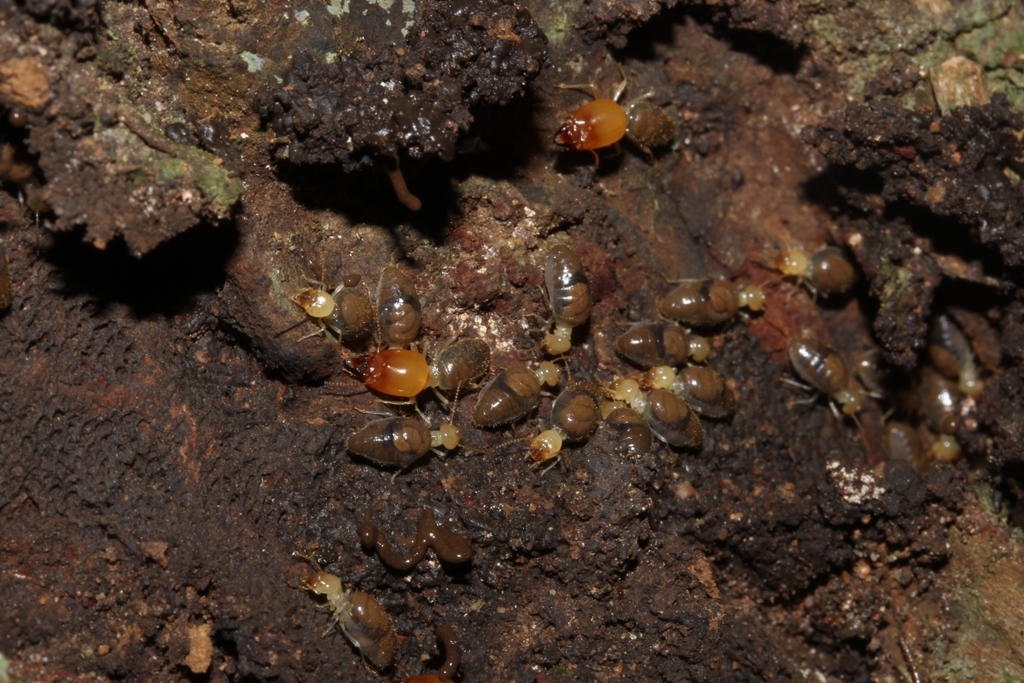
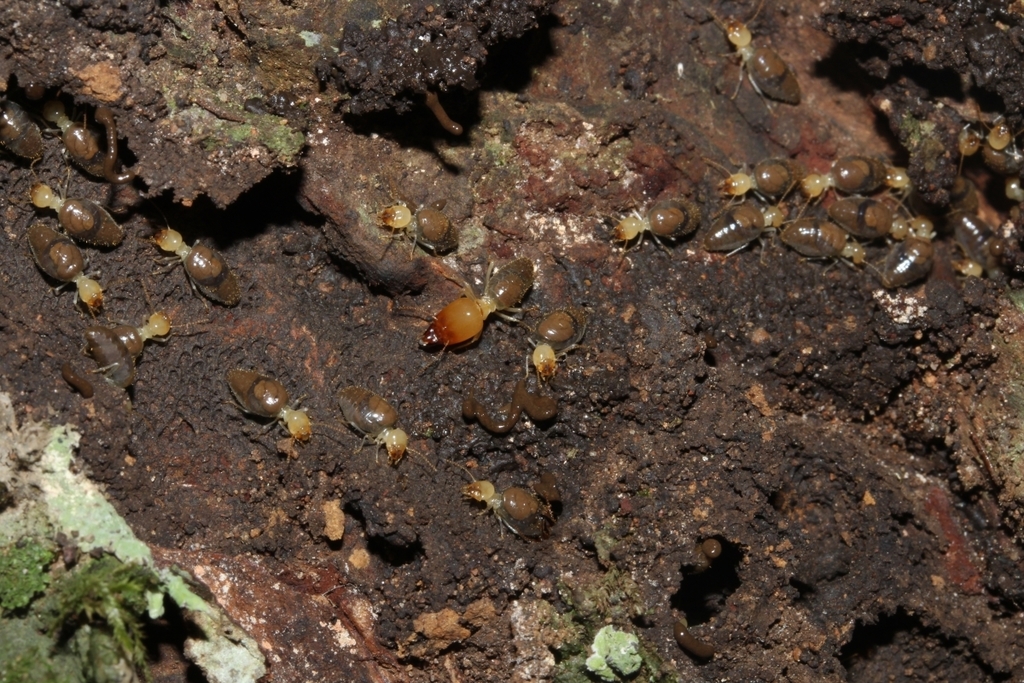
About the genus
This genus belongs to the family Termitidae 白蚁科, in the subfamily Syntermitinae 聚白蚁亚科; the site records 10 species.
Type species: Labiotermes labralis.
This page includes a distribution map for the genus (GBIF records aggregated on a 1° grid); open a species entry to see its type locality, distribution, and references.
Etymology
From Latin labium (lip) + termes.
The etymologies in this section are analytical breakdowns; the roots follow Brown (1956).
Morphology
The descriptions below are an adaptation of the original genus-level accounts; terms follow the meaning of the source, and the original is not transcribed verbatim.
Diagnostic characters
Holmgren 1912 established Labiotermes as a new subgenus within Cornitermes. The alate has large compound eyes and large ocelli set close against them, antennae of 17 segments, and mandibular tooth 1 larger than tooth 2; the soldier has a relatively short frontal tube, a long labrum with a transparent, sharply delimited tip, antennae of 13–15 segments, and at most 2 teeth in the middle of the left mandible; the worker has antennae of 14–15 (16) segments and mandibular tooth 1 longer than tooth 2. The original text further divides the group into two: one with soldier antennae of 15 segments, the left mandible bearing 2 middle teeth and the basal and middle teeth of the right mandible separate; the other with the alate unknown, soldier antennae of 13 segments, the left mandible without middle teeth and the basal and middle teeth of the right mandible fused.
Alate
Compound eyes large; ocelli large, very close to the compound eyes. Antennae of 17 segments. Mandibular tooth 1 larger than tooth 2.
Soldier
Frontal tube relatively short. Labrum long, with a sharply delimited transparent tip. Mandibles robust; left mandible with at most 2 teeth in the middle. Antennae of 13–15 segments.
Worker
Antennae of 14–15 (16) segments. Mandibular tooth 1 longer than tooth 2. The original text gives only these two diagnostic features for the worker of this subgenus and does not describe the rest separately (it still falls within the generic characters of Cornitermes).
Sources: Holmgren, N. 1912. Termitenstudien 3. Systematik der Termiten. Die Familien Mastotermitidae, Protermitidae und Mesotermitidae. Kungliga Svenska Vetenskapsakademiens Handlingar 48(4): 1–166, Taf. 1–4., p. 50(archive.org 项 biostor-184513 页面图像) This text is an adaptation, not a verbatim transcription of the original.
Literature notes
Edited notes based on the original literature, not transcriptions. The source markers in each paragraph point to archived records in .sources; full citations are listed below.
Generic revision and gut holobiont
According to the abstract, Constantino et al. (2006) revised the South American genus Labiotermes, recognising 10 species, providing keys to soldiers and workers and distribution maps for all species, and describing two new species, Labiotermes guasu from Amazonian rain forest and Labiotermes oreadicus from the Cerrado of central Brazil; the imagos of Labiotermes emersoni and Labiotermes orthocephalus are described for the first time, and the workers of all species are described and illustrated, including the enteric valve armature and the mixed segment.
According to the abstract, Marynowska et al. (2023) applied a holobiont multi-omics approach to Labiotermes labralis and found that the gut bacteria were dominated by Firmicutes, which declined gradually towards the posterior segments while Bacteroidetes, Proteobacteria and Verrucomicrobia increased; the gut microbiota expressed a high diversity of carbohydrate-active enzymes degrading cellulose and hemicelluloses, and the host's own cellulases differ in phylogenetic origin and structure.
References
- Constantino, R., Acioli, A. N. S., Schmidt, K., Cuezzo, C., Carvalho, S. H. C. & Alexandre, A. (2006). A taxonomic revision of the Neotropical termite genera Labiotermes Holmgren and Paracornitermes Emerson (Isoptera, Termitidae, Syntermitinae). Zootaxa, 1340.
- Marynowska, M., Sillam-Dussès, D., Untereiner, B., Klimek, D., Goux, X., Gawron, P., Roisin, Y., Delfosse, P. & Całusińska, M. (2023). A holobiont approach towards polysaccharide degradation by the highly compartmentalised gut system of the soil-feeding higher termite Labiotermes labralis. BMC Genomics, 24.
Species (10)
- Labiotermes brevilabius Emerson & Banks, 1965 短唇厚唇白蚁
- Labiotermes emersoni Araujo, 1954 埃默森厚唇白蚁
- Labiotermes guasu Constantino & Acioli, 2006 大厚唇白蚁
- Labiotermes labralis Holmgren, 1906 细唇厚唇白蚁 ★ Type species
- Labiotermes laticephalus Silvestri, 1901 宽头厚唇白蚁
- Labiotermes leptothrix Mathews, 1977 纤毛厚唇白蚁
- Labiotermes longilabius Silvestri, 1901 长唇厚唇白蚁
- Labiotermes oreadicus Constantino, 2006 山神厚唇白蚁
- Labiotermes orthocephalus Silvestri, 1901 直头厚唇白蚁
- Labiotermes pelliceus Emerson & Banks, 1965 毛头厚唇白蚁
Parent level: Checklist index · Syntermitinae 聚白蚁亚科 · Data & downloads