Genus Neotermes · 新白蚁属
Filter the taxa recorded under this genus by name and locality; for the whole site use the full-text search.
Distribution map
Photographs 50 photos · 8 species
Freely licensed photos; click to enlarge. This preview shows 6 photos; to browse by species, open “All photos”. Photos are hotlinked from iNaturalist / Wikimedia Commons; the rights stay with the photographers.



About the genus
This genus belongs to the family Kalotermitidae 木白蚁科; the site records 121 species, 2 subspecies.
Type species: Neotermes castaneus.
This page includes a distribution map for the genus (GBIF records aggregated on a 1° grid); open a species entry to see its type locality, distribution, and references.
Etymology
From Greek neos (new) + Latin termes.
The etymologies in this section are analytical breakdowns; the roots follow Brown (1956).
Fauna Sinica account
The account below is a reorganized and rewritten adaptation of the genus-level description in Fauna Sinica, Insecta Vol. 17, Isoptera (2000) (generic description in the original book's section on Neotermes, reorganised and rewritten); the source keys and measurement tables are not reproduced here.
Morphology
Key characters
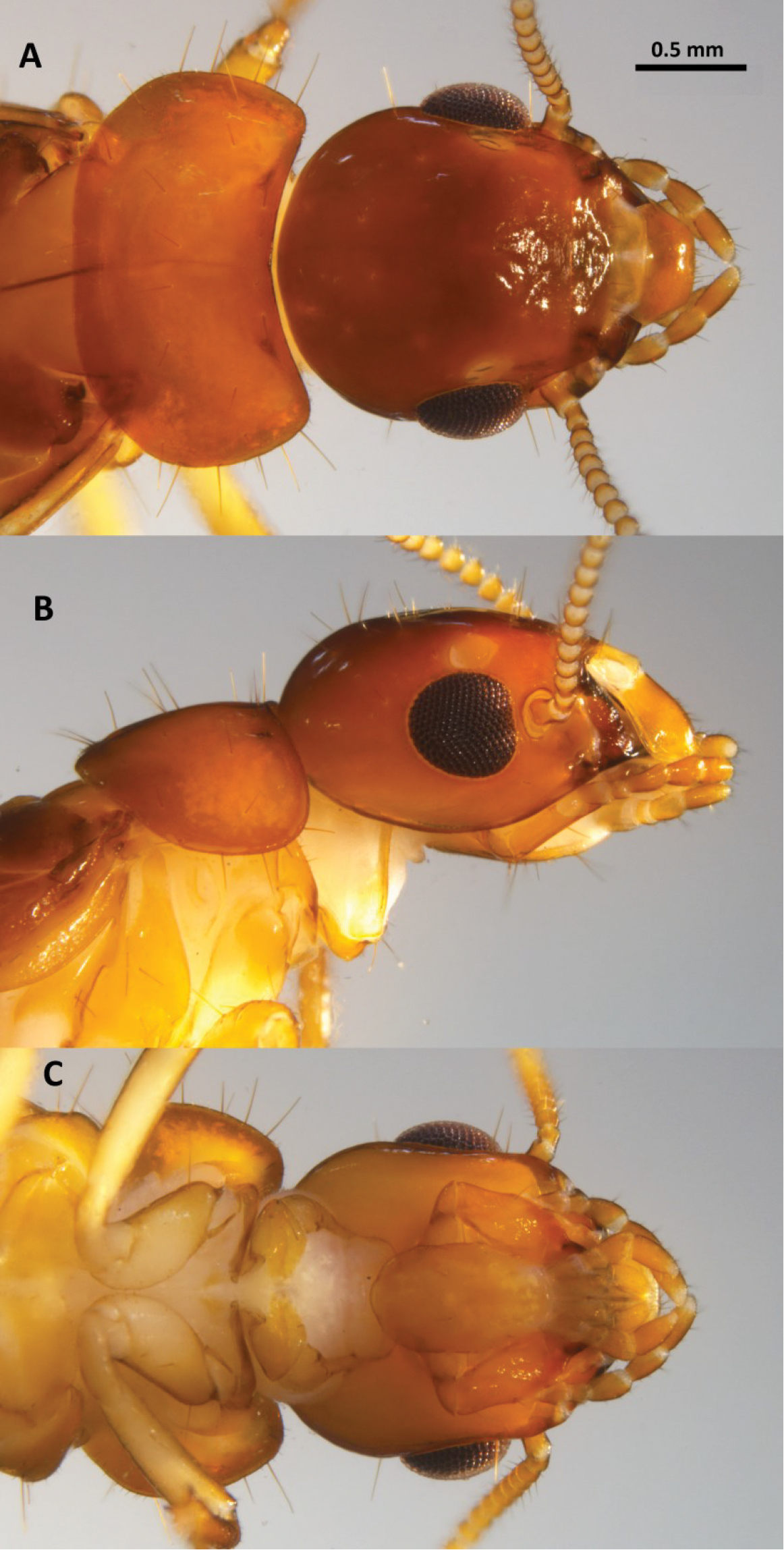
Soldier head rectangular, the frontal region raised and gradually sloping towards the clypeus; the inner margin of the left mandible with four to five marginal teeth, the right with two; antennae with twelve to sixteen segments, the third not especially swollen; cerci with two segments.
Soldier
Soldier fairly large, head rectangular, the dorsal and ventral surfaces rather flat. Frontal region raised, gradually sloping towards the clypeus. Mandibles stout and rather long, the inner margin of the left with four to five marginal teeth, the right with two. Labrum short and broad, its anterior margin broadly arcuate and the sides rounded, tongue-shaped. Antennae with twelve to sixteen segments, the third not especially swollen, slightly longer or slightly shorter than the second. Pale eye spots behind the antennal sockets. Postmentum with the sides of the widest part slightly concave or notched at the middle, the outline parallel or slightly narrowed posteriorly, the waist central. The median notch of the anterior margin of the pronotum broadly arcuate and shallow, the middle of the posterior margin slightly concave or nearly straight. Femora not swollen, tibial spur formula 3:3:3.
Alate
Alate head outline somewhat square, the posterior lateral corners broadly rounded, the two sides and the middle of the posterior margin rather straight. The inner margin of each mandible with two marginal teeth, the apical tooth slightly longer than the first marginal tooth, the posterior margin of the first marginal tooth of the left mandible fused with the second marginal tooth and longer than the anterior margin of the third marginal tooth. Labrum short, broad and tongue-shaped. Antennae with sixteen to nineteen segments, the third not larger than the second or the fourth. Compound eyes fairly large, projecting outwards below the lower margin of the head, the pair of ocelli on their inner side touching the compound eyes. Postmentum narrow and long. Pronotum transversely rectangular, short and broad, wider than the head, the median notch of the anterior margin broadly arcuate, the middle of the posterior margin slightly concave. Forewing scale large, its anterior margin projecting and covering the hindwing scale, media sclerotised. Legs slender, spur formula 3:3:3, an arolium between the claws, cerci with two segments.
Biology and economic significance
Neotermes species are wood-dwelling termites, usually living in damp wood that contains some moisture and in living tree trunks, hence they are also called dampwood termites. Besides damaging trees, they can also attack timber-framed houses and economic forest trees; in the swarming season a pair of reproductives may enter wood, tree stumps or structural timber to found a new colony and gradually spread the damage.
Distribution
Oriental Region, also found in the Americas and elsewhere; recorded from every province and autonomous region of southern China.
Summary
Neotermes soldiers are rather large, with a rectangular, flattened head and a raised frons sloping to the clypeus. The left mandible bears four or five marginal teeth and the right two; the labrum is short, broad and ligulate. Antennae have twelve to sixteen segments with an unenlarged third, and a pale eye spot sits behind the antennal fossa. The genus lives in moist timber and living trunks as a damp-wood termite, damaging trees, wooden buildings and plantations.
Sources cited: Huang Fusheng, Zhu Shimo, Ping Zhengming, Wang Zhiguo, Li Can and Xu Chungui, 2000. Fauna Sinica, Insecta Vol. 17, Isoptera. Beijing: Science Press. This text is a reorganized adaptation, not a verbatim transcription.
Species (121 species, 2 subspecies)
- Neotermes aburiensis Sjöstedt, 1926 阿布里新白蚁
- Neotermes acceptus Mathews, 1977 宜人新白蚁
- Neotermes adampurensis Akhtar, 1975 阿达姆普尔新白蚁
- Neotermes agilis Sjöstedt, 1902 轻快新白蚁
- Neotermes amplilabralis Xu & Han, 1985 宽唇新白蚁
- Neotermes andamanensis Snyder, 1933 安达曼新白蚁
- Neotermes angustigulus Han, 1984 细颏新白蚁
- Neotermes araguaensis Snyder, 1959 阿拉瓜新白蚁
- Neotermes aridus Wilkinson, 1959 干新白蚁
- Neotermes arthurimuelleri Rosen, 1912 阿图尔米勒新白蚁
- Neotermes artocarpi Haviland, 1898 阿托卡尔佩新白蚁
- Neotermes assamensis Maiti & Saha, 2000 阿萨姆新白蚁
- Neotermes assmuthi Holmgren, 1913 阿斯穆斯新白蚁
- Neotermes binovatus Han, 1984 双凹新白蚁
- Neotermes blairi Maiti & Chakraborty, 1994 布莱尔新白蚁
- Neotermes bosei Snyder, 1933 鲍斯新白蚁
- Neotermes brachynotum Xu & Han, 1985 扁胸新白蚁
- Neotermes brevinotus Snyder, 1932 短背新白蚁
- Neotermes buxensis Roonwal & Sen-Sarma, 1960 布克萨新白蚁
- Neotermes camerunensis Sjöstedt, 1900 喀麦隆新白蚁
- Neotermes castaneus Burmeister, 1839 栗色新白蚁 ★ Type species
- Neotermes chilensis Blanchard, 1851 智利新白蚁
- Neotermes collarti Coaton, 1955 科勒特新白蚁
- Neotermes connexus Snyder, 1922 连接新白蚁
- Neotermes costaseca Scheffrahn, 2018 干海岸新白蚁
- Neotermes cryptops Sjöstedt, 1900 隐秘新白蚁
- Neotermes cubanus Snyder, 1922 古巴新白蚁
- Neotermes dalbergiae Kalshoven, 1930 黄檀新白蚁
- Neotermes desneuxi Sjöstedt, 1904 德纳新白蚁
- Neotermes dhirendrai Bose, 1984 迪伦德拉新白蚁
- Neotermes dolichognathus Xu & Han, 1985 长颚新白蚁
- Neotermes dubiocalcaratus Han, 1984 异距新白蚁
- Neotermes eleanorae Bose, 1984 埃莉诺新白蚁
- Neotermes erythraeus Silvestri, 1918 微红新白蚁
- Neotermes europae Wasmann, 1910 欧罗巴新白蚁
- Neotermes ferrugineus Holmgren, 1911 锈色新白蚁
- Neotermes firmus Sjöstedt, 1911 坚固新白蚁
- Neotermes fletcheri Holmgren & Holmgren, 1917 弗莱彻新白蚁
- Neotermes fovefrons Xu & Han, 1985 洼额新白蚁
- Neotermes fujianensis Ping, 1983 福建新白蚁
- Neotermes fulvescens Silvestri, 1901 金黄新白蚁
- Neotermes gestri Silvestri, 1912 盖斯特新白蚁
- Neotermes glabriusculus Oliveira, 1979 光滑新白蚁
- Neotermes gnathoferrum Ware, Lal & Grimaldi, 2010 铁颚新白蚁
- Neotermes gracilidens Sjöstedt, 1925 细齿新白蚁
- Neotermes grandis Light, 1930 大新白蚁
- Neotermes greeni Desneux, 1908 格林新白蚁
- Neotermes hirtellus Silvestri, 1901 粗毛新白蚁
- Neotermes holmgreni Banks, 1918 霍姆格伦新白蚁
- Neotermes humilis Han, 1984 小新白蚁
- Neotermes insularis Walker, 1853 岛生新白蚁
- Neotermes intracaulis Scheffrahn & Krecek, 2003 茎内新白蚁
- Neotermes jouteli Banks, 1919 茹泰尔新白蚁
- Neotermes kalimpongensis Maiti, 1975 噶伦堡新白蚁
- Neotermes kanehirai Oshima, 1917 凯恩希拉新白蚁
- Neotermes kartaboensis Emerson, 1925 卡尔塔波新白蚁
- Neotermes kemneri Roonwal & Sen-Sarma, 1960 凯姆勒新白蚁
- Neotermes keralai Roonwal & Verma, 1972 喀拉拉新白蚁
- Neotermes ketelensis Kemner, 1932 凯特拉新白蚁
- Neotermes koshunensis Shiraki, 1909 恒春新白蚁
- Neotermes krishnai Bose, 1984 克里希纳新白蚁
- Neotermes lagunensis Oshima, 1920 内湖新白蚁
- Neotermes larseni Light, 1935 拉森新白蚁
- Neotermes laticollis Holmgren, 1910 宽颈新白蚁
- Neotermes lepersonneae Coaton, 1955 勒佩索纳新白蚁
- Neotermes longiceps Xu & Han, 1985 长头新白蚁
- Neotermes longipennis Kemner, 1930 长翅新白蚁
- Neotermes ludaoensis Wu, Tsai & Li, 2024 绿岛新白蚁
- Neotermes luykxi Nickle & Collins, 1989 卢伊克斯新白蚁
- Neotermes magnoculus Snyder, 1926 大眼新白蚁
- Neotermes malatensis Oshima, 1917 马拉蒂新白蚁
- Neotermes mangiferae Roonwal & Sen-Sarma, 1960 芒果新白蚁
- Neotermes medius Oshima, 1923 中部新白蚁
- Neotermes megaoculatus Roonwal & Sen-Sarma, 1960 巨眼新白蚁
- Neotermes meruensis Sjöstedt, 1907 梅鲁新白蚁
- Neotermes microculatus Roonwal & Sen-Sarma, 1960 小眼新白蚁
- Neotermes microphthalmus Light, 1930 小眸新白蚁
- Neotermes minutus Thapa, 1982 微小新白蚁
- Neotermes miracapitalis Xu & Han, 1985 奇头新白蚁
- Neotermes modestus Silvestri, 1901 适度新白蚁
- Neotermes mona Banks, 1919 莫纳新白蚁
- Neotermes nigeriensis Sjöstedt, 1911 尼日利亚新白蚁
- Neotermes nilamburensis Thakur, 1978 尼伦布尔新白蚁
- Neotermes ovatus Kemner, 1931 卵形新白蚁
- Neotermes pallidicollis Sjöstedt, 1902 灰颈新白蚁
- Neotermes papua Desneux, 1905 巴布亚新白蚁
- Neotermes paraensis Costa-Lima, 1942 帕拉新白蚁
- Neotermes paratensis Sen-Sarma & Thakur, 1975 帕拉蒂新白蚁
- Neotermes parviscutatus Light, 1930 小盾新白蚁
- Neotermes phragmosus Krecek & Scheffrahn, 2003 护穴新白蚁
- Neotermes pingshanensis Tan & Peng, 2009 屏山新白蚁
- Neotermes platyfrons Krecek & Scheffrahn, 2001 宽额新白蚁
- Neotermes prosonneratiae Akhtar, 1975 前海桑新白蚁
- Neotermes rainbowi Hill, 1926 雷恩鲍新白蚁
- Neotermes rhizophorae Maiti & Chakraborty, 1994 红树新白蚁
- Neotermes rouxi Holmgren & Holmgren, 1915 鲁新白蚁
- Neotermes saleierensis Kemner, 1932 萨莱尔新白蚁
- Neotermes samoanus Holmgren, 1912 萨摩亚新白蚁
- Neotermes sanctaecrucis Snyder, 1925 圣克鲁斯新白蚁
- Neotermes sarasini Holmgren & Holmgren, 1915 萨拉赞新白蚁
- Neotermes schultzei Holmgren, 1911 舒尔茨新白蚁
- Neotermes sepulvillus Emerson, 1928 缺附垫新白蚁
- Neotermes setifer Snyder, 1957 刚毛新白蚁
- Neotermes shimogensis Thakur, 1975 希莫加新白蚁
- Neotermes sinensis Light, 1924 中华新白蚁
- Neotermes sjostedti Desneux, 1908 舍斯泰特新白蚁
- Neotermes sonneratiae Kemner, 1932 海桑新白蚁
- Neotermes sphenocephalus Xu & Han, 1985 楔头新白蚁
- Neotermes sugioi Yashiro, 2019 杉尾新白蚁
- Neotermes superans Silvestri, 1928 充裕新白蚁
- Neotermes taishanensis Xu & Han, 1985 台山新白蚁
- Neotermes tectonae Dammerman, 1916 柚木新白蚁
- Neotermes tuberogulus Xu & Han, 1985 丘颏新白蚁
- Neotermes undulatus Xu & Han, 1985 波颚新白蚁
- Neotermes venkateshwara Bose, 1984 文卡特斯沃拉新白蚁
- Neotermes viraktamathi Ranjith & Kalleshwaraswamy, 2022 维拉格塔马蒂新白蚁
- Neotermes voeltzkowi Wasmann, 1897 弗尔特科新白蚁
- Neotermes wagneri Desneux, 1904 瓦格纳新白蚁
- Neotermes yunnanensis Xu & Han, 1985 云南新白蚁
- Neotermes zanclus Oliveira, 1979 镰刀新白蚁
- Neotermes zuluensis Holmgren, 1913 祖鲁新白蚁
- Neotermes megaoculatus lakhimpuri Roonwal & Sen-Sarma, 1960 勒金布尔亚种
- Neotermes megaoculatus megaoculatus Roonwal & Sen-Sarma, 1960 指名亚种
Parent level: Checklist index · Kalotermitidae 木白蚁科 · Data & downloads