Acanthotermes acanthothorax 刺胸刺白蚁
- Type locality
- Cameroon: Ekundu; Kitta
- Distribution
- Old World tropics, West Africa, Central Africa, East Africa
List: English (genus page) · 中文 · Español
Summary
Acanthotermes acanthothorax is the only extant species of the genus Acanthotermes, in the family TERMITIDAE (subfamily Macrotermitinae). The species was described by Sjöstedt in 1898; the type locality is Cameroon: Ekundu; Kitta. Distribution: Old World tropics, West Africa, Central Africa, East Africa.
Etymology
Genus name Acanthotermes: From Greek akantha (thorn) + Latin termes.
Specific epithet acanthothorax: From acantho + thorax
Taxonomic position
- Family: TERMITIDAE — 280 genera, 2144 species
- Subfamily: Macrotermitinae — 12 genera, 373 species
- Genus: Acanthotermes — monotypic, 1 species
Distribution
- Distribution records: Old World tropics, West Africa, Central Africa, East Africa
The record above follows the wording of the original data; no geocoding or standardized place names have been applied.
Morphology
The description below is paraphrased from the original or a later revision, by caste; the source is cited at the end.
Diagnostic characters
The soldier is dimorphic, with major and minor forms, and this is the most striking character of the genus; the alate has 20–23 antennal segments, the male with 1–2 more than the female, and the soldier 17–20. The anterior margin of the pronotum bears spines, and the lateral margins of the thoracic nota are more or less acute. All known species occur in Africa.
Alate
The head is broad and nearly circular. The compound eyes are medium-sized and projecting; the ocelli are slightly lateral and nearly circular, about one eye diameter from the compound eyes. Frontal gland pores are present. The base of the clypeus is even longer than half its width, rather narrow, strongly convex behind and straight in front, fairly raised, and distinctly brighter than the frons; the apex of the clypeus is transparent. The labrum is longer than wide and bears a chitinous transverse band. The mandible dentition is of the Termes type, tooth 1 of the left mandible slightly larger than tooth 2. The pronotum bears two small nodular projections on each side of the midline. The posterior emargination of the mesonotum is slightly wider than that of the metanotum. The wings are transparent, with brown veins at the base and along the anterior margin and a weakly reticulate membrane; the radial vein is reduced and does not extend beyond the wing scale; in the forewing the media is separate from the wing scale, while in the hindwing the media arises from the base of the radial sector, is slender, and branches towards the radial sector and the wing apex; the cubitus has a thickened internal vein. The sides of the abdomen bear exudate hairs, denser in the female; the male has styli.
Soldier
Major soldier: the head is more or less narrowed anteriorly, with parallel sides, oval to cordate, its posterior margin straight to strongly concave. The frontal gland pore is distinct, surrounded by a circular hairy area, with a spine-like elevation in front of the pore; the mandibular base is robust. The base of the clypeus is very short, the apex fairly large and transparent. The labrum is fairly broad, its apex trilobed and transparent. The mandibles are fairly short and robust, more or less strongly curved, each with a more or less sharp large basal tooth; the left mandible has in addition 3 to several fairly small nodular teeth, and the base of its apex often bears a notch and a tooth-like projection; the rest of the right mandible is toothless. The submentum is long, narrow and parallel-sided. The anterior margin of the pronotum bears two acute projections on each side of the midline, fairly small, and the anterior corners are fairly sharp; the lateral parts of the meso- and metanota are more or less acute. The legs are long, the last tarsomere distinctly longer than the rest together and slender. The cerci are large; the styli are present and small, or reduced. Minor soldier: the head is fairly parallel-sided, oval, widest at the level of the antennae; in profile both upper and lower surfaces are fairly convex, the lower especially wrinkled. The frontal gland pore is likewise surrounded by a ring of hairs, sometimes forming a tubular elevation, with a distinct spine on its anterior margin. The clypeus is fairly short, convex behind and straight in front, with a transparent apex. The labrum is pointed, its apex transparent and trilobed. The mandibles are narrow and weakly sickle-shaped; the base of the left mandible bears a tooth scar and the basal tooth is weakly developed. The antennae are long, with 15–20 segments, segment 2 shorter than segment 3. The submentum is longitudinally elongate, strongly convex, narrow and parallel-sided. The anterior margin of the pronotum bears spines. The cerci are large; the styli are present.
Worker
The worker is dimorphic. The head is large, broadly oval, with a distinct coronal suture, and the frontal gland pore is large and triangular. The base of the clypeus is short, far less than half its width, raised, and the apex is large. The labrum is longer than wide and bears a chitinous transverse band. The mandibles are shorter and wider than in the alate but with the same dentition. There are 17–21 antennal segments, segment 2 longer than segment 3. The pronotum has robust anterior projections. The legs are long, and the trochanter of the foreleg bears two robust anterior setae. The cerci are large; the styli are reduced.
This genus is monotypic, containing only this species; the following is the genus-level description based on the original literature; species-level measurements and intraspecific variation are given in the original.
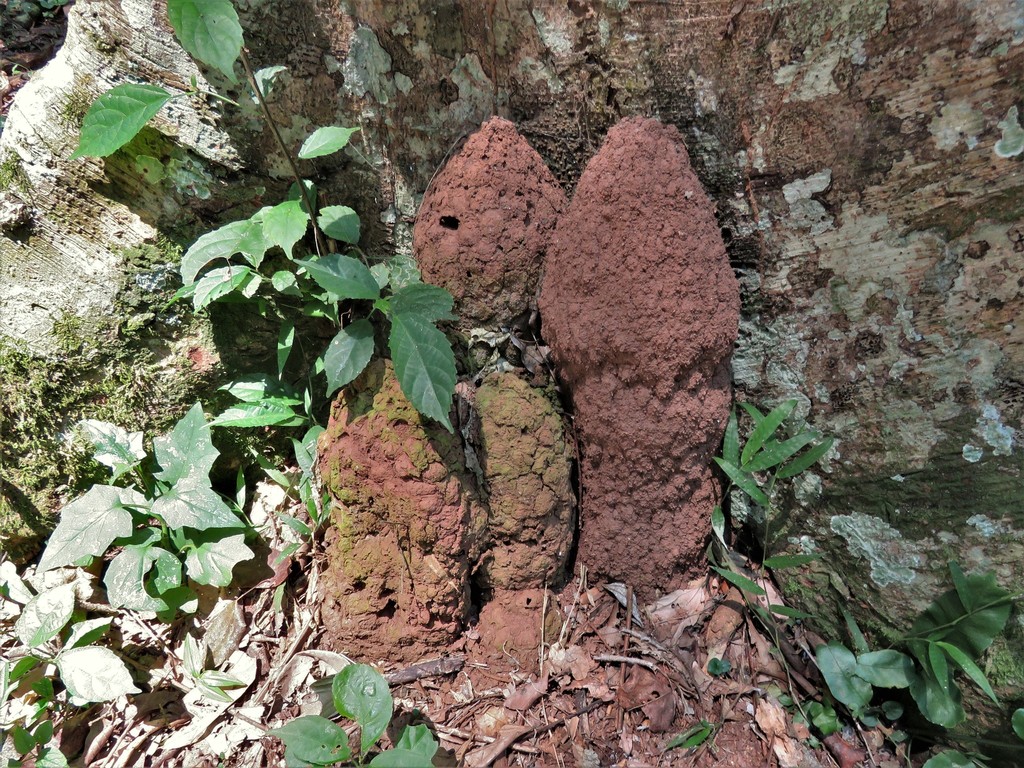
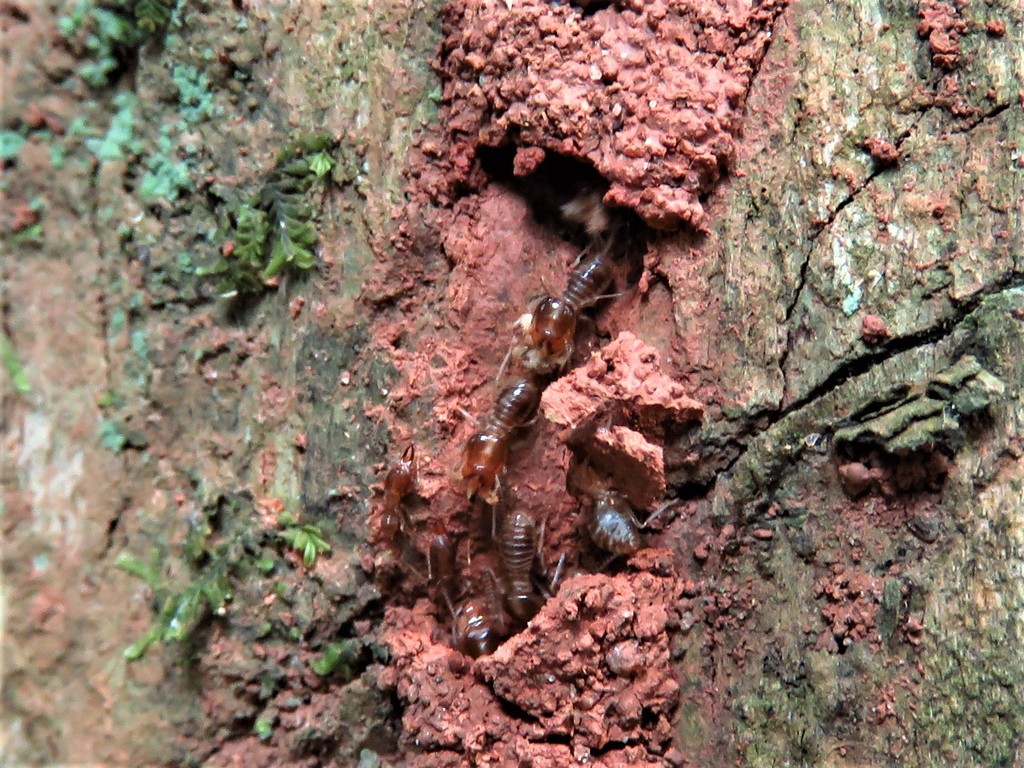
Photos 2 photos
Freely licensed photos, click to enlarge. Hotlinked from iNaturalist / Wikimedia Commons; the rights stay with the photographers — author, licence and source page are shown under each photo.
Distribution map
Aggregated from GBIF occurrence records on a 1° grid; only extant taxa of this checklist are used, so fossil records are excluded. Dot size and shade show the number of records inside a cell.
Related papers
Cached papers for this genus (matched automatically, for reference); to search this species with its junior synonyms merged in, use the literature search.
- Bemerkungen zu den Soldaten von Acanthotermes acanthothorax Sjöst. (Isoptera)
Abstract
- Trichotriurella minima Mendes 2002
Abstract
Trichotriurella minima Mendes, 2002 Trichotriurella minima Mendes 2002b: 123. Type data: holotype ♀ # I-1379 MRAC. Type locality: DRC, Mont Gafula, 3 km route Leopoldville. Type host: Acanthotermes acanthothorax (Sjostedt, 1898) [Termitidae]. Distribution. DRC, only known from type locality. Ecology. Termitophile with Acanthotermes acanthothorax (Sjostedt, 1898) [Termitidae].
- Dating the fungus‐growing termites’ mutualism shows a mixture between ancient codiversification and recent symbiont dispersal across divergent hosts
Abstract
The mutualistic symbiosis between fungus-growing termites and Termitomyces fungi originated in Africa and shows a moderate degree of interaction specificity. Here we estimate the age of the mutualism and test the hypothesis that the major splits have occurred simultaneously in the host and in the symbiont. We present a scenario where fungus-growing termites originated in the African rainforest just before the expansion of the savanna, about 31 Ma (19-49 Ma). Whereas rough age correspondence is observed for the four main clades of host and symbiont, the analysis reveals several recent events of host switching followed by dispersal of the symbiont throughout large areas and throughout different host genera. The most spectacular of these is a group of closely related fungi (the maximum age of which is estimated to be 2.4 Ma), shared between the divergent genera Microtermes, Ancistrotermes, Acanthotermes and Synacanthotermes (which diverged at least 16.7 Ma), and found throughout the African continent and on Madagascar. The lack of geographical differentiation of fungal symbionts shows that continuous exchange has occurred between regions and across host species.
Papers on this species, synonyms included → OpenAlex Google Scholar CNKI
Abstracts come from open metadata; copyright remains with the original authors/publishers. For reference only — please check the original.
Cite this species
Citation strings are generated from the fields of this page; please keep the DOI and the version number when citing.
GB/T 7714
班奈特格林. Extant Isoptera (termites): a checklist of Latin and Chinese names: Acanthotermes acanthothorax 刺胸刺白蚁[EB/OL]. Version 2026.10.30. https://termite-extant-isoptera.org/en/species/acanthotermes-acanthothorax/. DOI: 10.5281/zenodo.23646836.
BibTeX
@misc{isoptera_acanthotermes_acanthothorax_2026,
  author       = {班奈特格林},
  title        = {Acanthotermes acanthothorax: a checklist of extant Isoptera (termites)},
  year         = {2026},
  version      = {2026.10.30},
  howpublished = {https://termite-extant-isoptera.org/en/species/acanthotermes-acanthothorax/},
  note         = {TERMITIDAE; version 2026.10.30; DOI: 10.5281/zenodo.23646836},
  doi          = {10.5281/zenodo.23646836}
}
RIS
TY  - ELEC
TI  - Acanthotermes acanthothorax: a checklist of extant Isoptera (termites)
AU  - 班奈特格林
PY  - 2026
UR  - https://termite-extant-isoptera.org/en/species/acanthotermes-acanthothorax/
DO  - 10.5281/zenodo.23646836
ER  -