Dicuspiditermes laetus 明亮突扭白蚁
- Type locality
- Myanmar: Lower Myanmar: east side of Dawna Hills, Sukli
- Distribution
- Southeast Asia, Thailand, Bangladesh, Cambodia, China, India, Malaysia, Myanmar, Vietnam
List: English (genus page) · 中文 · Español
Summary
Dicuspiditermes laetus is a species of the genus Dicuspiditermes, in the family TERMITIDAE (subfamily Mirocapritermitinae). The species was described by Silvestri in 1914; the type locality is Myanmar: Lower Myanmar: east side of Dawna Hills, Sukli. Distribution: Southeast Asia, Thailand, Bangladesh, Cambodia, China, India, Malaysia, Myanmar, Vietnam. This site records 3 junior synonyms for the species.
Etymology
Genus name Dicuspiditermes: From Latin di- (two) + cuspis (point) + termes.
Specific epithet laetus: Latin laetus (joyful, bright)
Taxonomic position
- Family: TERMITIDAE — 280 genera, 2144 species
- Subfamily: Mirocapritermitinae — 14 genera, 135 species
- Genus: Dicuspiditermes — 21 species
- Type species of the genus: Dicuspiditermes obtusus
Distribution
- Distribution records: Southeast Asia, Thailand, Bangladesh, Cambodia, China, India, Malaysia, Myanmar, Vietnam
The record above follows the wording of the original data; no geocoding or standardized place names have been applied.
Junior synonyms
This site records 3 junior synonyms for the species, listed by their original literature source:
- Capritermes garthwaitei Gardner, 1945: 106-108 — type locality: Myanmar: Maymyo
- Dicuspiditermes orientalis Harris, 1968: 147-148 — type locality: Vietnam: Cau Da
- Dicuspiditermes tripurensis Sen-Sarma & Thakur, 1979: 21-23 — type locality: India: Tripura: Tiliamura
In older literature, regional checklists and database searches, this species may appear under the synonyms above (Capritermes garthwaitei, Dicuspiditermes orientalis, Dicuspiditermes tripurensis); this site treats them all under Dicuspiditermes laetus.
Recorded in Fauna Sinica
The morphological and biological accounts below are taken from Fauna Sinica and related literature; only structure and punctuation have been standardized here.
Morphology
Soldier
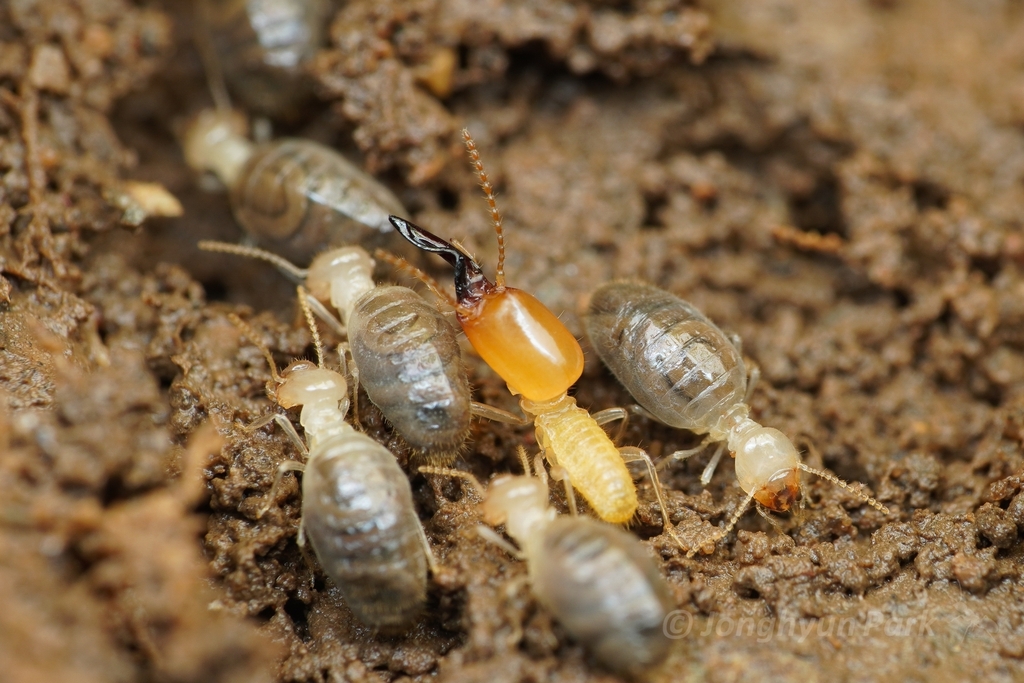
Head straw yellow, abdomen white. Only a few hairs on the top of the frons, still sparser elsewhere, the abdomen with many hairs. Head cylindrical, raised like a mountain peak at the anterior sixth; the fontanelle situated behind the midpoint between the peak-like process and the labrum; in profile the anterior and posterior margins of the frontal process meeting almost at a right angle; the back of the head slightly broader than the front; a hard horn on the anterolateral side of each antenna. Mandibles twisted and asymmetrical, the tip of the left mandible hooked, the right rather straight. The anterior margin of the labrum forked into two sharp points. Antennae with 14 segments, the second, third and fourth of similar length, all shorter than the fifth. The notch of the anterior margin of the pronotum not very distinct. Abdomen short and small. The head capsule moderately to rather densely haired, the head rectangular and without frontal ridges; the middle of the left mandible moderately twisted, its tip hooked and swollen behind the hook, the right mandible sword-shaped with its tip also slightly hooked; labrum narrow and long, its anterior margin concave, the anterolateral angles slightly projecting; tibial spur formula 2:2:2.
Alate
Head dark red, the first and second antennal segments, labrum, posterior part of the mandibles and legs brownish yellow, postclypeus and pronotum dull yellowish brown, the venter of the abdomen paler, wings yellowish brown. The whole body densely covered with fine hairs. Head oval, the top flat; fontanelle elongate-oval; compound eyes circular and projecting, ocelli elongate-oval, the ocellus-compound eye distance about equal to the width of the ocellus; postclypeus raised, more than one-third as long as wide, its posterior margin arched forwards, the anterior margin straight. Antennae with 15 segments, the third finest and shortest, the second about twice as long as the third, the fourth shorter than the second and longer than the third. Pronotum with a pale cross-shaped marking, the anterior margin straight, the median notch indistinct, the anterolateral angles projecting, the middle of the posterior margin slightly concave. Forewing M arising independently at the humeral suture, situated between Rs and Cu and slightly towards Cu, dividing into four branches beyond two-thirds of the wing length, Cu with about 9–10 branches; hindwing M arising from Rs behind the humeral suture, the rest as in the forewing. The head capsule rather densely haired, the frontal gland pore small and narrow, oval; the postclypeus less than half as long as wide, with a median suture; the distance between the apical tooth and the first marginal tooth of the right mandible slightly greater than that between the first and second marginal teeth.
Worker
Nymph
Abstract (from the source)
Soldiers are straw-yellow with a white abdomen. The cylindrical head bears a peak-like elevation at the anterior sixth, a fontanelle behind it, and a hard horn outside each antennal socket; the frontal protrusion meets at nearly a right angle in profile. Mandibles are twisted and asymmetric, the left hooked and the right straighter, and the labrum ends in two needle-like points. Antennae have 14 segments. Alates are dark red with yellowish-brown wings and dense fine hair, an oval head with flat vertex, oblong fontanelle and protruding eyes, and 15-segmented antennae. The pronotum shows a pale cross-shaped mark, and the forewing media divides into four branches.
Biology
Distribution and locality
Jinping (380 m, 450 m), Mojiang (1400 m) and Jinghong (500 m), Yunnan; abroad recorded from Myanmar.
Taxonomic notes
The original work records Dicuspiditermes garthwaitei, which is now placed in synonymy under D. laetus.
Source: Huang Fusheng et al. (2000), Fauna Sinica, Insecta vol. 17, Isoptera, Science Press. (entry no. 356 in the original work) Entries are cited by their number in the original work.
Photos 1 photo
Freely licensed photos, click to enlarge. Hotlinked from iNaturalist / Wikimedia Commons; the rights stay with the photographers — author, licence and source page are shown under each photo.
Distribution map
Aggregated from GBIF occurrence records on a 1° grid; only extant taxa of this checklist are used, so fossil records are excluded. Dot size and shade show the number of records inside a cell.
Related papers
Cached papers for this genus (matched automatically, for reference); to search this species with its junior synonyms merged in, use the literature search.
- A new species and a new record of Dicuspiditermes Krishna (Blattodea: Isoptera: Termitidae) from the Kerala part of Western Ghats, India
Abstract
A new species, Dicuspiditermes leghugathrae Amina and Rajmohana sp.nov. (Termitidae) is described and illustrated based on the morphological characters of soldiers and workers. Dicuspiditermes hutsoni (Kemner), a termite species hitherto endemic to Sri Lanka, is reported for the first time from India. Both the species are recorded from the Kerala part of Western Ghats. An identification key to the species of Dicuspiditermes found in India (based on soldier caste), along with a species distribution map is also provided.http://www.zoobank.org/urn:lsid:zoobank.org:act:44AB093B-6A02-4A35-BC1B-3277259A3104
- Effect of the soil-feeding termite, Dicuspiditermes makhamensis, on soil carbon structure in a seasonal tropical forest as revealed by CP/MAS 13C NMR
Abstract
- Allomorphuroides dicuspiditermina Mendes 1987
Abstract
Allomorphuroides dicuspiditermina Mendes, 1987 Allomorphuroides dicuspiditermina Mendes 1987: 55. Type data: syntypes 31♂♂ 22♀♀ PCLM. Type locality: Malaysia, Sabah, Sepilok near Sandakan. Type host: Dicuspiditermes nemorosus (Haviland, 1898) [Termitidae]. Distribution. Malaysia (Sabah), only known from type locality. Ecology. Termitophile with Dicuspiditermes nemorosus (Haviland, 1898) [Termitidae].
Papers on this species, synonyms included → OpenAlex Google Scholar CNKI
Abstracts come from open metadata; copyright remains with the original authors/publishers. For reference only — please check the original.
Other species in Dicuspiditermes (20 species)
- Dicuspiditermes achankovili
- Dicuspiditermes boseae
- Dicuspiditermes cacuminatus
- Dicuspiditermes cornutella
- Dicuspiditermes fissifex
- Dicuspiditermes fontanellus
- Dicuspiditermes gravelyi
- Dicuspiditermes hutsoni
- Dicuspiditermes incola
- Dicuspiditermes kistneri
- Dicuspiditermes leghugathrae
- Dicuspiditermes makhamensis
- Dicuspiditermes minutus
- Dicuspiditermes nemorosus
- Dicuspiditermes obtusus
- Dicuspiditermes punjabensis
- Dicuspiditermes rothi
- Dicuspiditermes santschii
- Dicuspiditermes sisiri
- Dicuspiditermes spinitibialis
Cite this species
Citation strings are generated from the fields of this page; please keep the DOI and the version number when citing.
GB/T 7714
班奈特格林. Extant Isoptera (termites): a checklist of Latin and Chinese names: Dicuspiditermes laetus 明亮突扭白蚁[EB/OL]. Version 2026.10.30. https://termite-extant-isoptera.org/en/species/dicuspiditermes-laetus/. DOI: 10.5281/zenodo.23646836.
BibTeX
@misc{isoptera_dicuspiditermes_laetus_2026,
  author       = {班奈特格林},
  title        = {Dicuspiditermes laetus: a checklist of extant Isoptera (termites)},
  year         = {2026},
  version      = {2026.10.30},
  howpublished = {https://termite-extant-isoptera.org/en/species/dicuspiditermes-laetus/},
  note         = {TERMITIDAE; version 2026.10.30; DOI: 10.5281/zenodo.23646836},
  doi          = {10.5281/zenodo.23646836}
}
RIS
TY  - ELEC
TI  - Dicuspiditermes laetus: a checklist of extant Isoptera (termites)
AU  - 班奈特格林
PY  - 2026
UR  - https://termite-extant-isoptera.org/en/species/dicuspiditermes-laetus/
DO  - 10.5281/zenodo.23646836
ER  -