Genus Dicuspiditermes · 突扭白蚁属
Filter the taxa recorded under this genus by name and locality; for the whole site use the full-text search.
Distribution map
Photographs 1 photo · 1 species
Freely licensed photos; click to enlarge. This preview shows 6 photos; to browse by species, open “All photos”. Photos are hotlinked from iNaturalist / Wikimedia Commons; the rights stay with the photographers.
About the genus
This genus belongs to the family Termitidae 白蚁科, in the subfamily Mirocapritermitinae 瘤白蚁亚科; the site records 21 species.
Type species: Dicuspiditermes obtusus.
This page includes a distribution map for the genus (GBIF records aggregated on a 1° grid); open a species entry to see its type locality, distribution, and references.
Etymology
From Latin di- (two) + cuspis (point) + termes.
The etymologies in this section are analytical breakdowns; the roots follow Brown (1956).
Fauna Sinica account
The account below is a reorganized and rewritten adaptation of the genus-level description in Fauna Sinica, Insecta Vol. 17, Isoptera (2000) (genus-level account reorganised and rewritten from the Dicuspiditermes section of the original book); the source keys and measurement tables are not reproduced here.
Morphology
Key characters
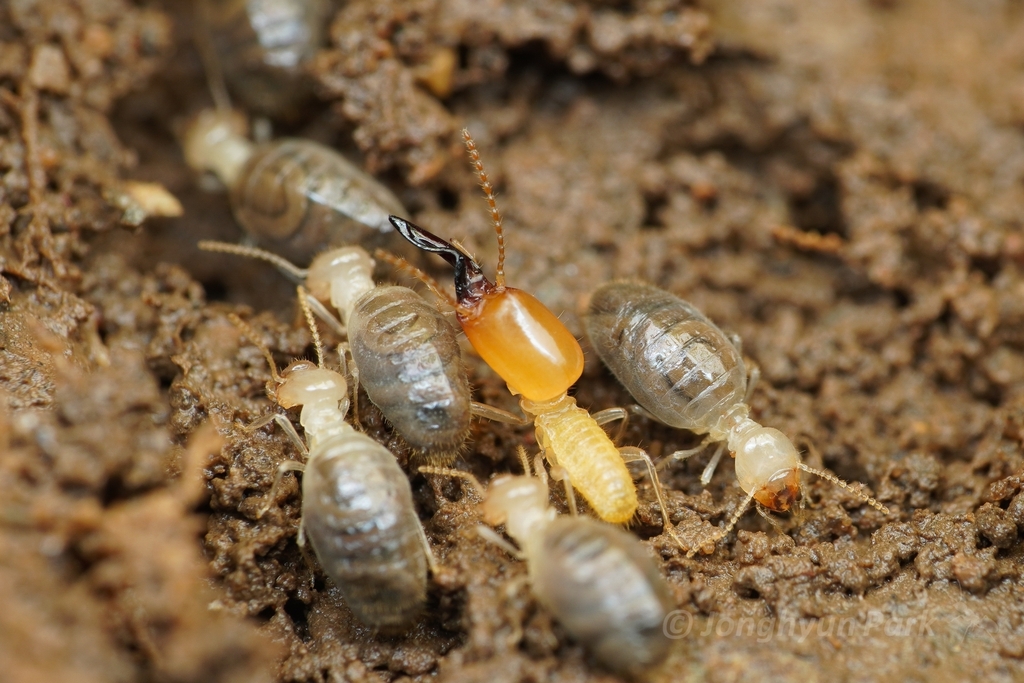
Soldier with a rectangular head, the anterior part raised; an anterolateral process below each antennal socket; mandibles asymmetrical, the left twisted into a hook, the right straight as a blade; lateral corners of the labrum projecting forwards like needles; antennae 14-segmented; pronotum saddle-shaped.
Soldier
Soldier with a rectangular head capsule, the anterior part raised, with an anterolateral horn-like process on each side below the antennal sockets. Mandibles asymmetrical: the left twisted, its apex curved inwards into a hook; the right straighter, blade-like. Anterior margin of the labrum deeply concave, the lateral corners slender as needles and projecting far forwards. Antennae 14-segmented. Pronotum saddle-shaped, its width far less than the head width.
Alate
Alate with a broad oval head capsule, slightly narrowed anteriorly, densely covered with long and short hairs. Fontanelle generally slender, slit-like; compound eyes elliptical; ocelli oval and separate from the compound eyes. Postclypeus raised. Apical tooth of the left mandible short, slightly larger than or almost equal to the first marginal tooth, which in turn is larger than the second; the posterior margin of the first marginal tooth of the right mandible long. Antennae 14–15-segmented.
Distribution
Oriental region; distributed in tropical and subtropical areas, recorded from southern China.
Summary
Soldiers of Dicuspiditermes have a rectangular head raised in front, with a projecting anterolateral corner beneath each antennal socket. The mandibles are asymmetric: the left is twisted and hooked at the apex, the right is straight and sabre-like. The labrum is deeply notched in front and its lateral corners extend forward as long needle-like points. Antennae are 14-segmented and the pronotum is saddle-shaped, much narrower than the head. The genus is Oriental.
Sources cited: Huang Fusheng, Zhu Shimo, Ping Zhengming, Wang Zhiguo, Li Can and Xu Chungui, 2000. Fauna Sinica, Insecta Vol. 17, Isoptera. Beijing: Science Press. This text is a reorganized adaptation, not a verbatim transcription.
Species (21)
- Dicuspiditermes achankovili Verma, 1985 阿坚柯维尔突扭白蚁
- Dicuspiditermes boseae Chhotani, 1997 鲍斯突扭白蚁
- Dicuspiditermes cacuminatus Krishna, 2001 尖齿突扭白蚁
- Dicuspiditermes cornutella Silvestri, 1922 小角突扭白蚁
- Dicuspiditermes fissifex Krishna, 2001 裂开突扭白蚁
- Dicuspiditermes fontanellus Thakur & Chatterjee, 1971 小囟突扭白蚁
- Dicuspiditermes gravelyi Silvestri, 1922 格雷夫利突扭白蚁
- Dicuspiditermes hutsoni Kemner, 1926 赫特森突扭白蚁
- Dicuspiditermes incola Wasmann, 1893 栖息突扭白蚁
- Dicuspiditermes kistneri Krishna, 2001 基斯特纳突扭白蚁
- Dicuspiditermes laetus Silvestri, 1914 明亮突扭白蚁
- Dicuspiditermes leghugathrae Amina & Rajmohana, 2020 莱古加思突扭白蚁
- Dicuspiditermes makhamensis Ahmad, 1965 玛堪突扭白蚁
- Dicuspiditermes minutus Akhtar & Riaz, 1992 小突扭白蚁
- Dicuspiditermes nemorosus Haviland, 1898 树荫突扭白蚁
- Dicuspiditermes obtusus Silvestri, 1923 迟钝突扭白蚁 ★ Type species
- Dicuspiditermes punjabensis Holmgren & Holmgren, 1917 旁遮普突扭白蚁
- Dicuspiditermes rothi Holmgren, 1913 罗思突扭白蚁
- Dicuspiditermes santschii Silvestri, 1922 桑特斯基突扭白蚁
- Dicuspiditermes sisiri Chhotani, 1997 西西尔突扭白蚁
- Dicuspiditermes spinitibialis Krishna, 2001 刺胫突扭白蚁
Parent level: Checklist index · Mirocapritermitinae 瘤白蚁亚科 · Data & downloads