Nasutitermes parvonasutus 小象白蚁
- Type locality
- Taiwan: ?
- Distribution
- China (Taiwan)
List: English (genus page) · 中文 · Español
Summary
Nasutitermes parvonasutus is a species of the genus Nasutitermes, in the family TERMITIDAE (subfamily Nasutitermitinae). The species was described by Nawa in 1911; the type locality is Taiwan: ?. Distribution: China (Taiwan). This site records 1 junior synonym for the species.
Etymology
Genus name Nasutitermes: From Latin nasutus (large-nosed) + termes, for the nasute soldier.
Specific epithet parvonasutus: From the descriptive term ‘parv’ (small)
Taxonomic position
- Family: TERMITIDAE — 280 genera, 2144 species
- Subfamily: Nasutitermitinae — 81 genera, 606 species
- Genus: Nasutitermes — 243 species
- Type species of the genus: Nasutitermes corniger
Distribution
- Distribution records: China (Taiwan)
The record above follows the wording of the original data; no geocoding or standardized place names have been applied.
Junior synonyms
This site records 1 junior synonym for the species, listed by its original literature source:
- Eutermes (Eutermes) watasei Holmgren, 1912: 134-136 — type locality: Taiwan: ?
In older literature, regional checklists and database searches, this species may appear under the synonym Eutermes (Eutermes) watasei; this site treats it under Nasutitermes parvonasutus.
Recorded in Fauna Sinica
The morphological and biological accounts below are taken from Fauna Sinica and related literature; only structure and punctuation have been standardized here.
Morphology
Soldier
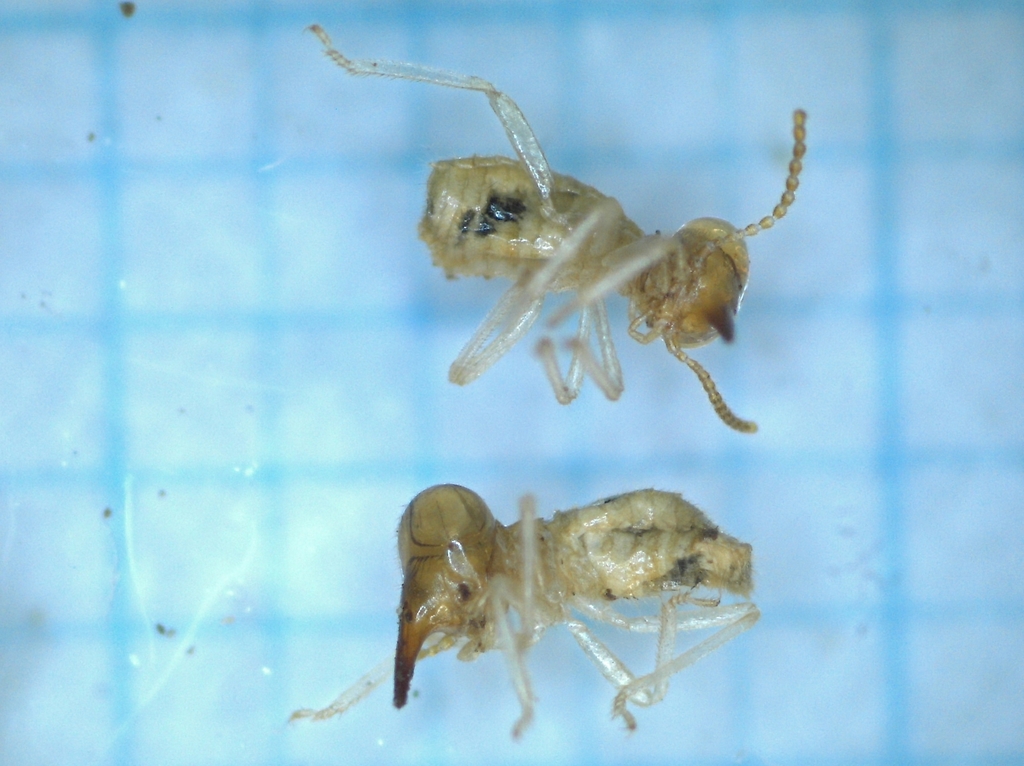
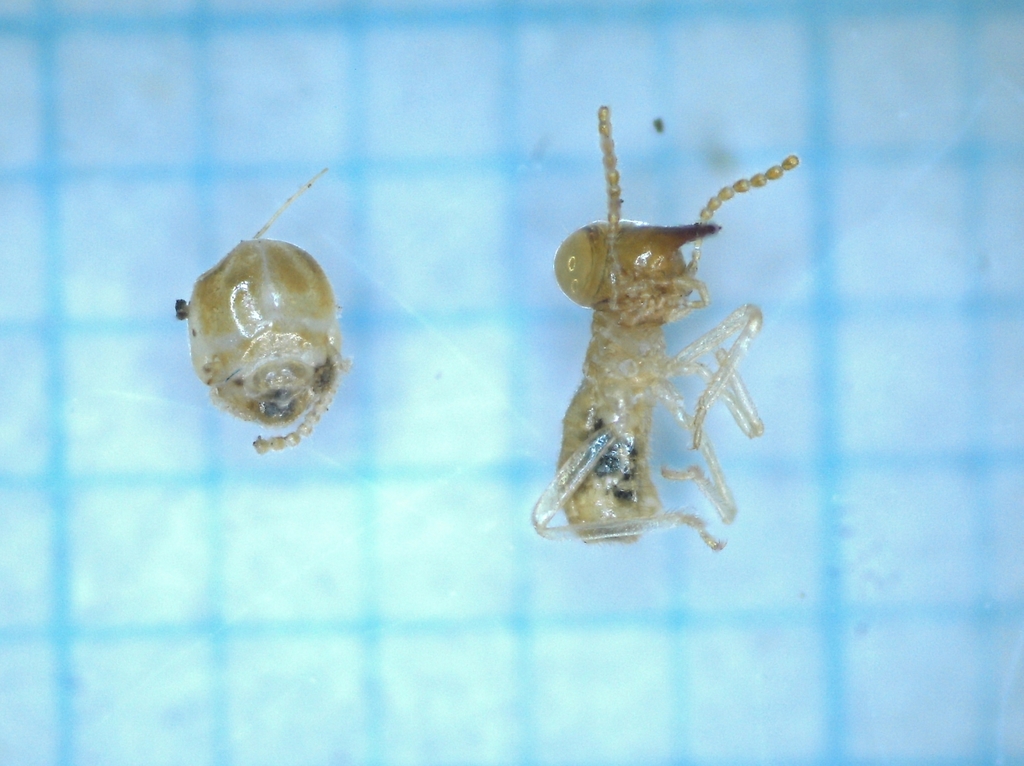
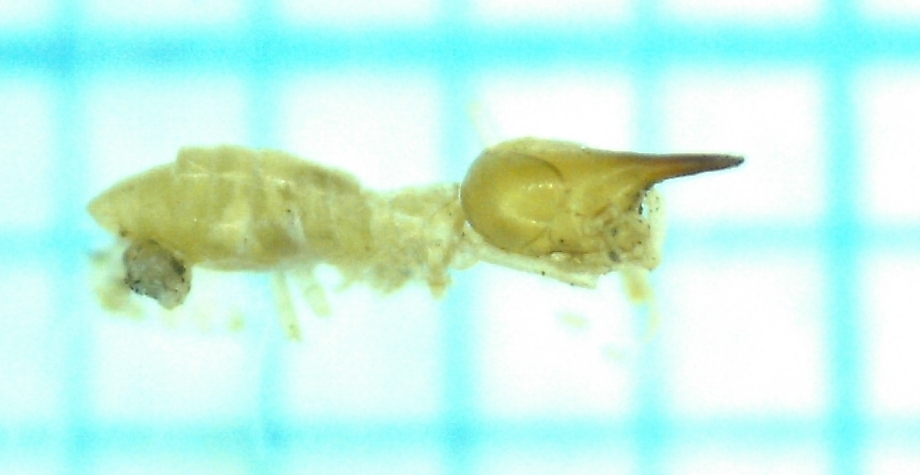
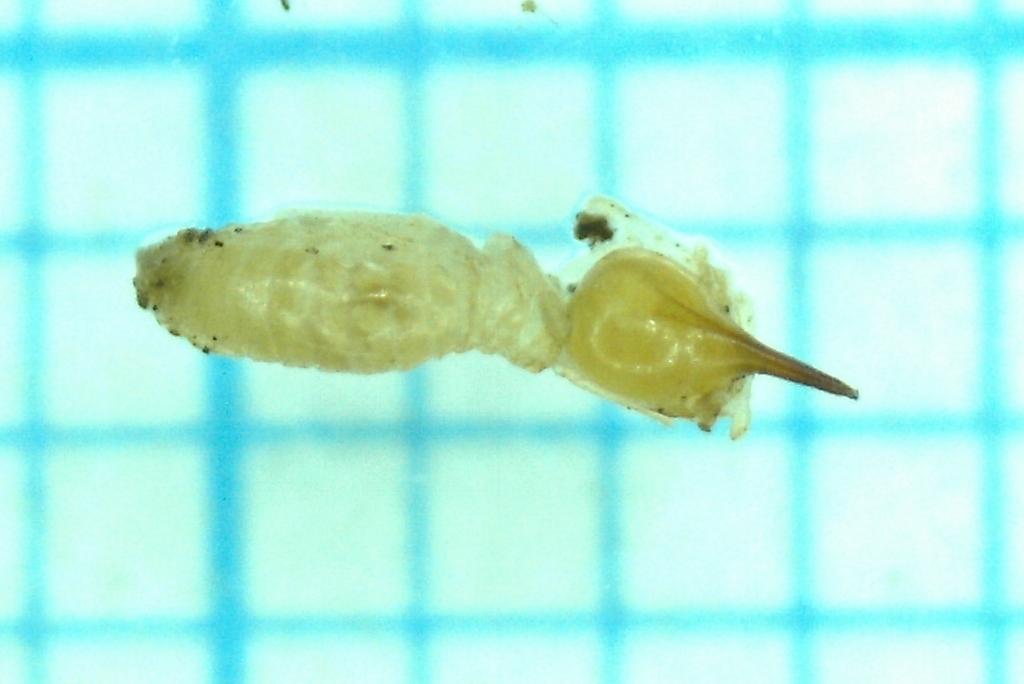
In the soldier one antennal segment is incompletely divided, thus forming a longer segment. The anterior and posterior halves of the pronotum almost equal in width, the anterior part erect or slightly inclined backwards, the anterior margin without a median notch.
Alate
Head of the alate brown, antennae, labrum and postclypeus yellow; pronotum paler than the head and with a yellow T-shaped marking; anterior part of the mesonotum and metanotum yellow, the posterior part brown; dorsum of the abdomen brown, the ventral surface slightly yellow; wings semi-transparent, pale blackish brown, the veins darker. Head and pronotum densely covered with hairs. Head broadly oval, with a pit in the middle of the vertex, fontanelle small and slit-like. Antennae with 15 segments, segment 3 smallest, segment 2 smaller, segments 4 and 6 nearly equal in length. Compound eyes small and round, ocelli oval, the ocellus-compound eye distance about equal to the length of the ocellus; postclypeus arched, the anterior margin nearly straight, the posterior margin bowing out. Pronotum narrower than the head, 1.5 times as wide as long, the anterior margin nearly straight and slightly raised, the middle of the posterior margin notched. Media of the forewing unbranched or with one to three branches, situated close to the cubitus, the cubitus with eight to ten oblique branches; media of the hindwing arising from the radial sector behind the humeral suture, the rest as in the forewing.
Worker
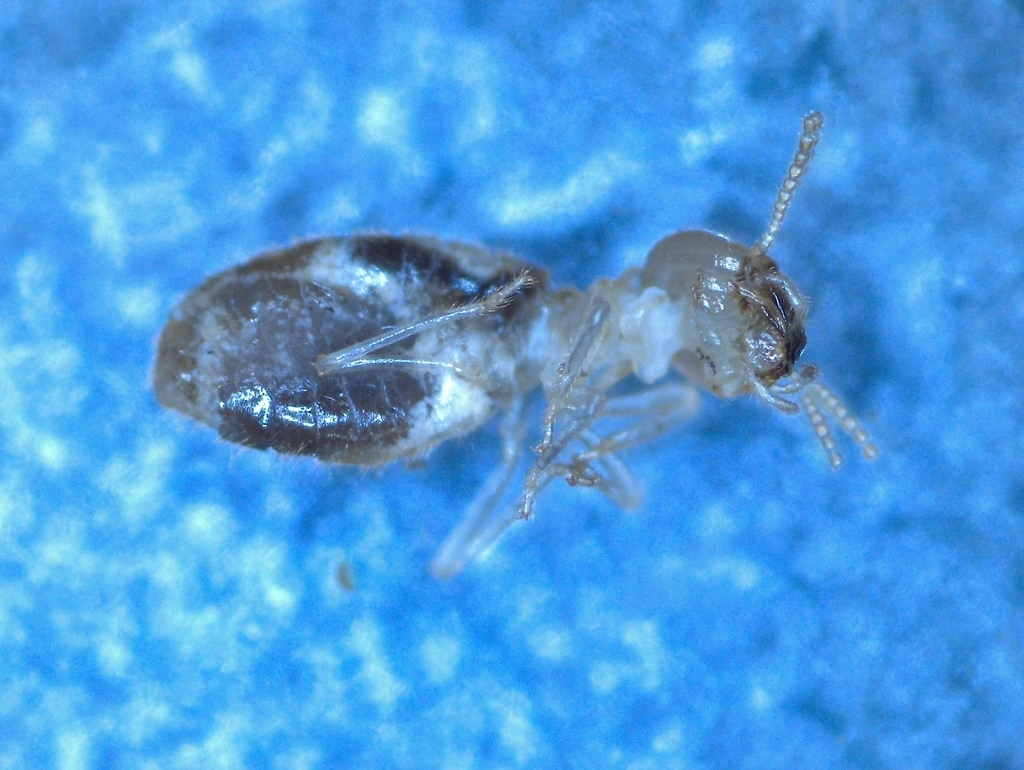
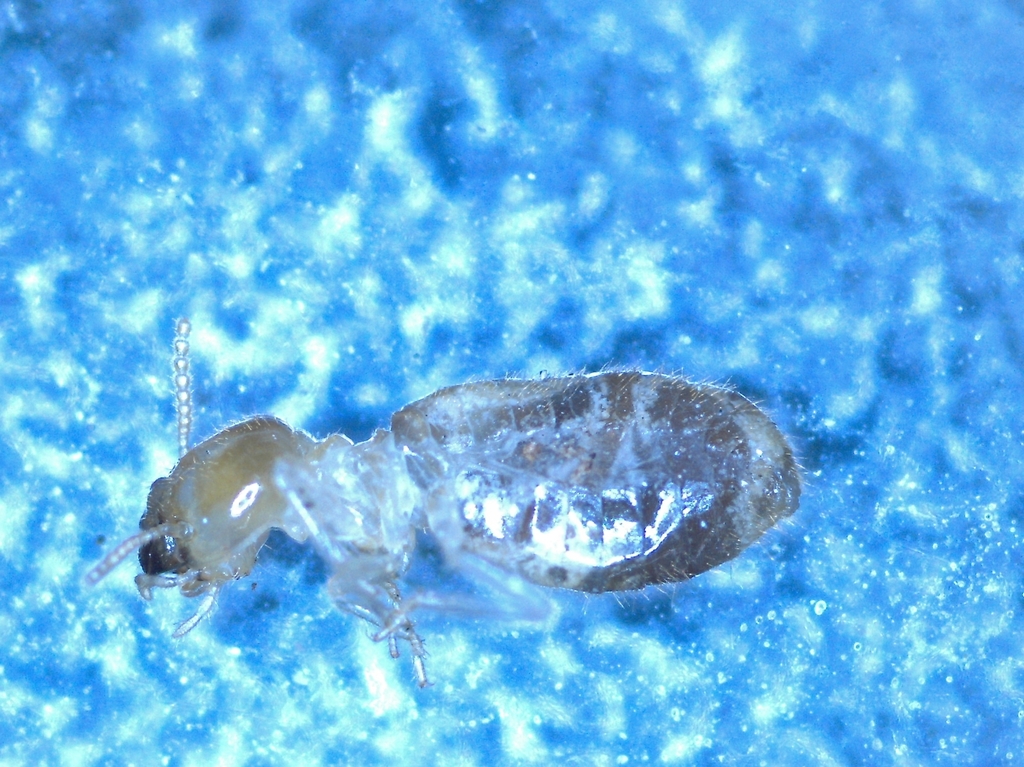
Head of the worker yellow, abdomen almost white. The head with a few short hairs, the dorsum of the abdomen densely covered with short hairs, the ventral surface also with short hairs, the posterior end of each segment with a row of long hairs. Head oval, the vertex flat, the dorsum with a pale T-shaped marking; total length 4.72 to 5 mm, postclypeus slightly arched, about one third as long as wide. Antennae with 14 segments, segment 4 shortest, segments 2 and 3 about equal in length. Anterior part of the pronotum erect, the anterior margin deeply notched in the middle.
Nymph
Abstract (from the source)
The soldier's antennae include a segment only partly divided, forming an unusually long one, and the pronotum has front and rear halves of nearly equal width, the front erect or slightly reclined, with no notch in the middle. Alates are brown with yellow antennae, labrum and postclypeus, a broadly oval head, small round eyes, oval ocelli and 15 antennal segments; the forewing media is unbranched or gives one to three branches.
Biology
Distribution and locality
Hengchun, Taiwan; Changjiang, Yongan, Jianou and Nanping, Fujian.
Taxonomic notes
Source: Huang Fusheng et al. (2000), Fauna Sinica, Insecta vol. 17, Isoptera, Science Press. (entry no. 429 in the original work) Entries are cited by their number in the original work.
Photos 9 photos
Freely licensed photos, click to enlarge. Hotlinked from iNaturalist / Wikimedia Commons; the rights stay with the photographers — author, licence and source page are shown under each photo. Only the first 6 are shown here; the rest are under “All photos” at the end of the page.
Distribution map
Aggregated from GBIF occurrence records on a 1° grid; only extant taxa of this checklist are used, so fossil records are excluded. Dot size and shade show the number of records inside a cell.
Related papers
Cached papers for this genus (matched automatically, for reference); to search this species with its junior synonyms merged in, use the literature search.
- The site of cellulose breakdown in higher termites (Nasutitermes walkeri and Nasutitermes exitiosus)
Abstract
- Defensive behavior of a termite (Nasutitermes exitiosus)
Abstract
- Attraction of Neotropical Nasutitermes Termites to Carrion
Abstract
Papers on this species, synonyms included → OpenAlex Google Scholar CNKI
Abstracts come from open metadata; copyright remains with the original authors/publishers. For reference only — please check the original.
Other species in Nasutitermes (242 species)
- Nasutitermes acajutlae
- Nasutitermes acangussu
- Nasutitermes acutus
- Nasutitermes aduncus
- Nasutitermes alticola
- Nasutitermes amboinensis
- Nasutitermes anamalaiensis
- Nasutitermes anjiensis
- Nasutitermes anoniensis
- Nasutitermes aquilinus
- Nasutitermes araujoi
- Nasutitermes arborum
- Nasutitermes arenarius
- Nasutitermes aruensis
- Nasutitermes atripennis
- Nasutitermes aurantius
- Nasutitermes balingtauagensis
- Nasutitermes banksi
- Nasutitermes bannaensis
- Nasutitermes bashanensis
- Nasutitermes benjamini
- Nasutitermes bikpelanus
- Nasutitermes bivalens
- Nasutitermes boengiensis
- Nasutitermes boetoni
- Nasutitermes bolivari
- Nasutitermes bolivianus
- Nasutitermes brachynasutus
- Nasutitermes brevioculatus
- Nasutitermes brevirostris
- Nasutitermes brunneus
- Nasutitermes bulbiceps
- Nasutitermes bulbus
- Nasutitermes callimorphus
- Nasutitermes camerunensis
- Nasutitermes carnarvonensis
- Nasutitermes castaneus
- Nasutitermes celebensis
- Nasutitermes centraliensis
- Nasutitermes ceylonicus
242 species in this genus. See all species on the genus page →
Cite this species
Citation strings are generated from the fields of this page; please keep the DOI and the version number when citing.
GB/T 7714
班奈特格林. Extant Isoptera (termites): a checklist of Latin and Chinese names: Nasutitermes parvonasutus 小象白蚁[EB/OL]. Version 2026.10.30. https://termite-extant-isoptera.org/en/species/nasutitermes-parvonasutus/. DOI: 10.5281/zenodo.23646836.
BibTeX
@misc{isoptera_nasutitermes_parvonasutus_2026,
  author       = {班奈特格林},
  title        = {Nasutitermes parvonasutus: a checklist of extant Isoptera (termites)},
  year         = {2026},
  version      = {2026.10.30},
  howpublished = {https://termite-extant-isoptera.org/en/species/nasutitermes-parvonasutus/},
  note         = {TERMITIDAE; version 2026.10.30; DOI: 10.5281/zenodo.23646836},
  doi          = {10.5281/zenodo.23646836}
}
RIS
TY  - ELEC
TI  - Nasutitermes parvonasutus: a checklist of extant Isoptera (termites)
AU  - 班奈特格林
PY  - 2026
UR  - https://termite-extant-isoptera.org/en/species/nasutitermes-parvonasutus/
DO  - 10.5281/zenodo.23646836
ER  -